Challenge
What made the project particularly complex was not just the domain, but the startup reality behind it: the need to launch fast, validate early, and continuously improve the product, all without breaking what had already been built.
At the start, there were no finalized requirements, no established user flows, and no direct competitors to benchmark against. The MVP had to be defined, designed, and delivered under time pressure, while still laying the groundwork for a system that could later support clinics, healthcare providers, and large-scale adoption.
As the product transformed, new challenges didn’t replace the old ones — they stacked on top of them. Specifically, new challenges emerged around technical implementation and long-term product vision.
Among the key challenges were:
- Rapidly changing requirements — Features were introduced, redefined, and sometimes replaced mid-development as the client tested assumptions and reacted to user feedback.
- Scaling functionality — Expanding from a simple health record concept into a multi-module ecosystem without introducing performance bottlenecks or architectural debt.
- Cross-platform support — Delivering a consistent user experience across iOS, Android, and a web-based admin panel.
- Secure data exchange — Ensuring safe communication between mobile apps and the client’s back end via REST API, with authentication mechanisms evolving over time.
- Real-time interaction — Implementing reliable patient-clinician communication where message delivery, ordering, and fallback mechanisms had to work under real-world conditions, not ideal ones.
- Future integrations — Preparing the application for wearable device connectivity and clinic-level adoption.
Solutions
To bring the client’s idea to life, we assembled a full development team for the MVP stage, covering mobile, backend, QA, UI/UX, and project management. Together, we defined the product architecture, selected the technology stack, and delivered a cross-platform mobile application that could validate the client’s concept on the market.
From the very beginning, we emphasized scalability and security, ensuring the MVP would serve as a strong foundation for future growth. Every architectural and UX decision was guided by the long-term vision of a platform that could achieve broad adoption in the healthcare sector, supporting everyday users as well as clinics and care teams.
Key elements of our approach included:
- Technology stack selection: We chose React Native to ensure rapid development and consistent user experience across iOS and Android, while integrating it with a backend connected via REST API. This balance allowed the client to iterate quickly without compromising stability.
- Backend integration: Although the backend was developed on the client’s side, our team defined clear API requirements and implemented seamless communication between the mobile front end and the server, including secure authentication flows.
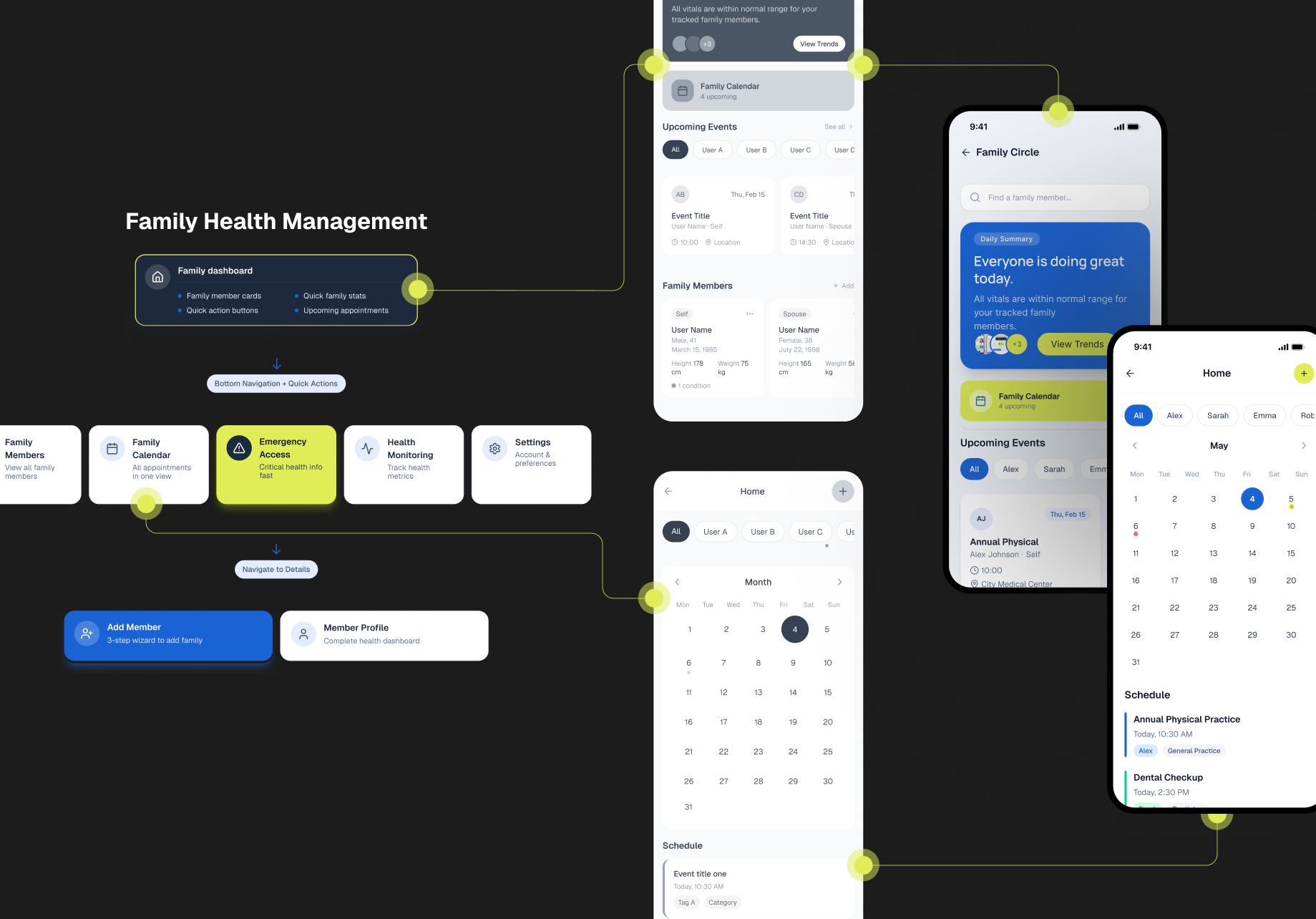
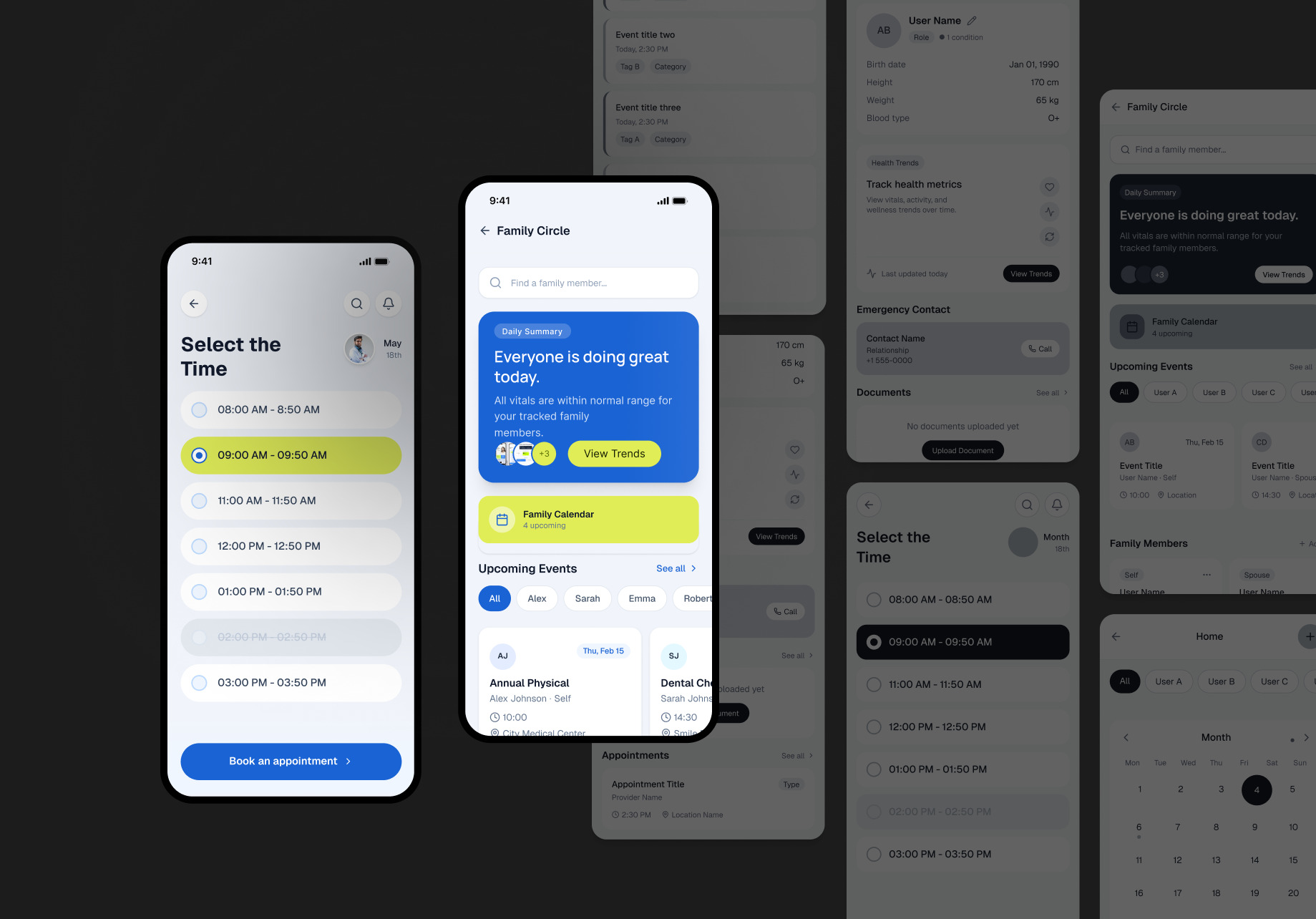
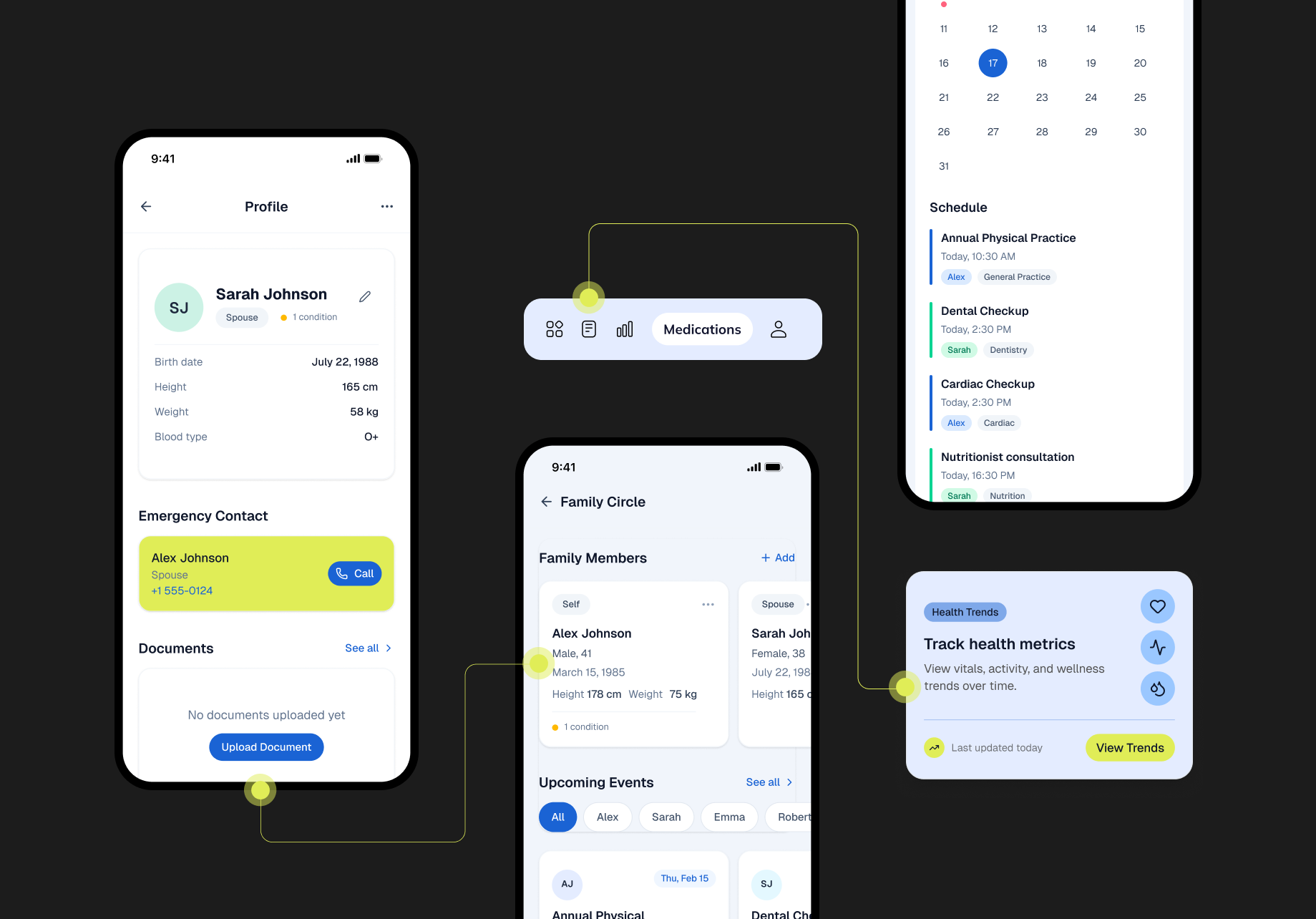
- User experience and interface design: We ensured that every feature, from profiles and medical records to activity tracking and notifications, was intuitive and accessible to a wide range of users, including patients of different ages and technical proficiency.
- Data security and compliance: Given the sensitive nature of healthcare data, we built in role-based access, secure storage, and encrypted data transfer to align with GDPR and HIPAA standards.
- Scalability in mind: Even at the MVP stage, we prepared the system for planned features like medication management, immunization records, and integration with third-party health services. The flexible architecture makes it possible to extend the app for nationwide use, enabling consistent functionality across thousands of users and supporting integrations at the clinic level.
Delivery Timeline
Phase 1 — MVP definition & architecture (Weeks 1-4)
- Defining core user flows and feature scope
- Establishing scalable architecture and API contracts
- Designing UX for fast adoption across different user types
Phase 2 — MVP development (Weeks 5-16)
- Cross-platform mobile development (iOS + Android)
- Backend integration via REST APIs
- Implementation of core features: authentication, profiles, medical records, basic tracking
- QA and stabilization for production release
Result:
A production-ready MVP delivered within 16 weeks, ready for real users and early adopters.
Phase 3 — iterative scaling (post-MVP)
- Expansion to 50+ features
- Introduction of real-time communication
- Advanced health tracking and reporting
- Preparation for clinic-level adoption and integrations
One of the most critical technical challenges was ensuring that early architectural decisions would not limit future expansion. Features like real-time communication, offline data logging, and healthcare integrations were not all part of the initial MVP scope, but the system had to be ready for them from day one. This required designing for capabilities that were not yet fully defined — a common but high-risk scenario in startup environments.
Technical Highlights
● Cross-platform mobile (iOS/Android) on React Native with a shared TypeScript codebase and a web-based admin panel — one product surface, three clients.
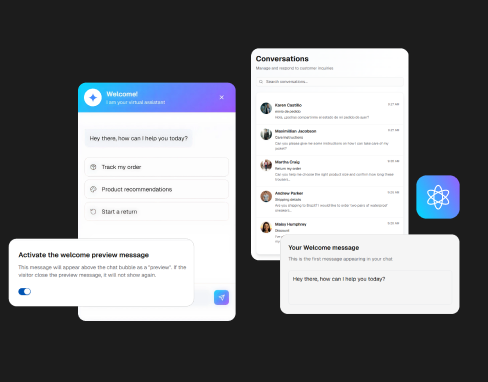
● Real-time layer over SignalR/WebSockets with reconnection, message ordering, and push-notification fallback for patient-clinician chat and care-team events.
● Offline-first data sync with a local encrypted store, queued mutations, and conflict resolution — patients can log vitals, symptoms, and documents without connectivity.
● Security by design: biometric login, two-factor auth, certificate pinning, encrypted at-rest storage (Keychain/Keystore), encrypted transport, and role-based access aligned with GDPR and HIPAA principles.
● Healthcare-ready data model designed to be FHIR-aligned, simplifying future interoperability with clinic EHR systems and national health registries.
● Wearable-ready architecture: a normalization layer for vitals and activity signals, prepared for HealthKit, Health Connect, and BLE device pairing.
In addition to the core MVP functionality, the app has expanded into a comprehensive health management solution with the following features:
User & profile management
- Secure registration and login with two-factor authentication
- Personal profiles with demographic data, physical parameters, and pre-existing conditions
- Adding and managing dependents (children, elderly relatives)
Health data & medical records
- Uploading and storing medical documents, test results, and charts
- Importing documents from email and messengers
- Structured health reports automatically generated for easy sharing
- Allergy, immunization, and medication records
Health tracking & assessments
- Interactive body map for symptom tracking
- Logging vitals (blood pressure, heart rate, weight, etc.) and body measurements
- Activity and lifestyle tracking (steps, fitness, nutrition, sleep, habits)
- Health assessments providing insights into trends and changes
Care management & collaboration
- Following personalized care plans with progress tracking
- Real-time chat between patients and clinicians (WebSockets)
- Patient–doctor invites and secure collaboration with care teams
- Sharing reports and documents directly with healthcare providers
Reminders & notifications
- Scheduled reminders for medications and health-related tasks
- Notifications for new messages, care plan updates, and clinician requests
Emergency & accessibility
- QR code generation for emergency access to records
- Multilingual interface for broader adoption
Planned & upcoming functionality
- Integration with wearable devices for continuous monitoring
- Extended clinic-level adoption (dashboards, EHR data exchange, FHIR endpoints)
- Telemedicine module with secure video and structured visit notes
AI-powered capabilities (in design)
- Document intelligence — OCR + LLM extraction that turns uploaded lab results and prescriptions into structured, searchable records with normalized units.
- Personal health assistant — a RAG layer over the patient’s own records, answering questions with citations to source documents, never producing diagnoses.
- Smart summaries for clinicians — auto-generated visit briefs from chat history, vitals, and care-plan progress, reviewed by a human before use.
- Anomaly detection on vitals and activity streams to surface early signals to the care team.
- Privacy-first ML: on-device inference for sensitive signals, EU data residency, and design aligned with the EU AI Act high-risk system requirements.
Today, the project continues to evolve with our dedicated mobile/front-end developer, who has been supporting the app’s growth and ensuring smooth integration of new features. Our contributions include extending the mobile app with new modules, maintaining the connection between the mobile front end and backend, and preparing the groundwork for future telemedicine integration. Through this blended model — full-team involvement at the foundation stage and dedicated expertise for ongoing enhancements — we’ve ensured continuity, technical consistency, and long-term product stability.






 Secure authentication