




How to Build a Tech Team That Scales With Your Product

You can hire a few people to shape a working MVP in weeks. Yet, several months later, if everything goes well and the product is growing, that same team is often drowning under scaling-product challenges. The best engineers give notice, and the architecture starts to buckle under traffic pressure.
The most likely mistake here: you kept the pre-MVP team while the product entered the scaling stage.
Based on our work with dozens of product teams at these inflection points, we’ve seen what works and what burns teams out. Here’s the playbook for building and managing your team at different maturity stages.
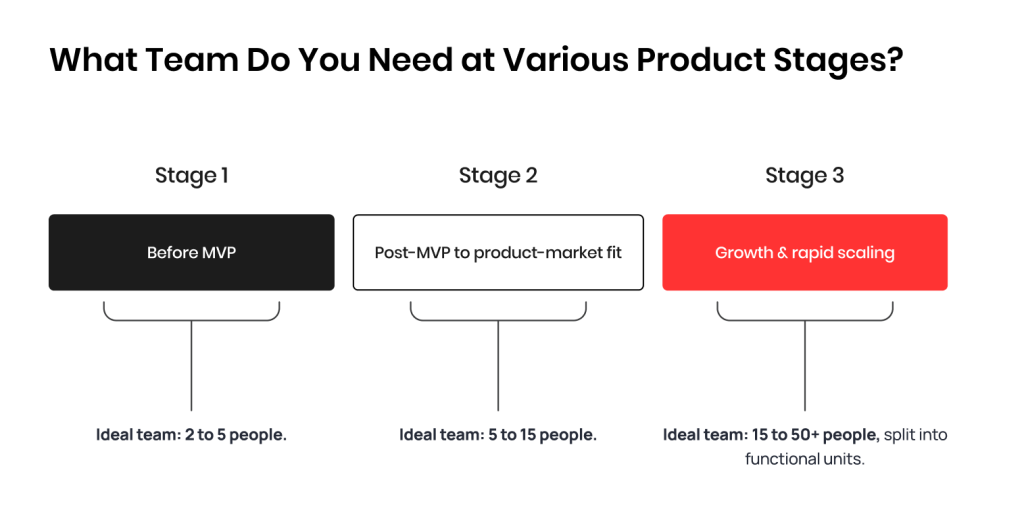
What Team Do You Need at Various Product Stages?
As your product shifts from a speculative bundle of features into a high-impact engine serving thousands of users, your team has to adapt at the same rate. Here’s the optimal team composition depending on the product stage:
| Stage | Target team | Roles | Objective | Risks |
| Ideation & Pre-MVP | 2-5 people | Technical Co-Founder, Full-Stack Generalist, Fractional UX Designer | Rapid prototyping, hypothesis testing, fast validation | Over-engineering, bikeshedding architecture |
| Post-MVP to PMF | 5-15 people | Senior Full-Stack Engineers, Early Product Manager, DevOps | Feature iteration, code stabilization, tech debt management | Feature creep, burning out core builders |
| Growth & Scaling | 15-50+ people | Specialized Backend/Frontend/Data Engineers, QA Lead | System availability, horizontal scale, modular architecture | Communication bottlenecks, cultural dilution |
Now let’s take a closer look at what your team may look like at different stages and how product maturity may influence your hiring decisions.
Stage 1. Before MVP
Ideal team: 2 to 5 people. A technical co-founder or lead developer, one or two strong full-stack generalists, and a part-time designer.
Your only important team metric is how fast your people can learn. Writing perfect tests or designing for scale is a waste of money at the beginning of your project. Prioritize searching for your market-proven value, testing hypotheses, and dragging a first working version into existence with the smallest burn possible.
What you need is a team of Swiss Army knives: engineers who’ll work on database logic, write an API endpoint, throw together a frontend, and deploy to a cloud server all at once. Look for people who can hold their perfectionism loosely, because most of this code might die later.
Stage 2. Post-MVP to product-market fit
Ideal team: 5 to 15 people. You add dedicated roles: senior full-stack engineers, an early product manager (often the founder stepping into an operational PM seat), and a DevOps who owns infrastructure and deployment stability.
Early traction flips your startup objective from “does anyone on the market want this?” to “expand & stabilize.” That’s why your early-stage generalists hit a wall: they have to move fast on user feedback and ship stable software at the same time.
You need more T-shaped builders: engineers who keep a broad grasp of the stack but bring depth in one domain, whether that’s reliability, front-end, or data. Your central job here is also about taming the tech debt you racked up during the pre-MVP sprint. That balance is harder than it sounds: in McKinsey’s survey of CIOs, tech debt accounts for 20 to 40 percent of the total value of a company’s technology — for larger organizations, that means hundreds of millions of dollars in unpaid debt.
Stage 3. Growth & rapid scaling
Ideal team: 15 to 50+ people, split into functional units.
Once you’ve locked in real product-market fit, the capital shows up, and so do aggressive acquisition targets. Then your systems start hitting performance ceilings. The early codebase demands modularization, microservice separation, and hardened security layers. That means you need extra hands to fix it.
Look for more domain specialists. You hire dedicated data engineers, security experts, QA automation leads, and tech managers with niche expertise based on your business plans to coordinate high-level execution across all units you created.
Simple Rules to Avoid Mis-Hire When Requirements Are Blurred
As the project grows, rigid job descriptions grow obsolete fast: the engineer you hired to build web interfaces in month one may be designing data pipelines in half a year. Hiring against a specific tech stack checklist is how you end up with someone who’s useless the moment the engineering roadmap turns. Here’s how to hire for the turn instead.
Stop asking about React hooks
Hand candidates a problematic part of your code and give them some limited time to debug it. You’ll learn more from watching someone reason through unfamiliar, messy code than from any amount of theoretical answers to standardized questions.
Test for ownership under ambiguity
In culture-fit interviews, watch how people react to missing inputs. For example, ask them: “Tell me about a high-priority feature you got with conflicting requirements and no spec. What did you do to move it forward?”. Listen for the person who seeks context, builds a rough prototype to get feedback quickly, and speaks with business objectives in mind.
Watch the generalist-to-specialist handoff
Your starting-stage generalists will often struggle with the narrow focus that the later stages demand, and your late-stage specialists tend to seize up in an environment with no structure.
That’s why you need to map your operational horizon ahead of time.
When you cross any stage boundary, tell your team how their roles will change and route them toward tech lead tracks, specialized strike teams, or system architect roles where their whole-system context is an advantage.
Establishing a Healthy Work Culture for Keeping Your Top Talent
It’s true that recruiting senior engineers is expensive and slow. Engineering roles now take about 62 days to fill globally, roughly three weeks longer than the average job, and senior roles sit at the top of that range. If that hire leaves within a year, you’re back to recruiting while the startup loses speed. On the other hand, team retention comes from building a culture that doesn’t grind them down.
Here’s another hard truth: the mess itself is what drives good experts out. In Stack Overflow’s survey, 62% of professional developers named technical debt their biggest frustration at work. Engineers often burn out from avoidable complications: the same workaround every week, the fragile module nobody wants to touch, shipping around problems instead of solving them.
So make cleanup a rule. Carve out up to 1/5 of every sprint as free-refactor time: no PM questions, no Jira tickets, no justification required, just engineers cleaning up the mess on their own judgment.
Note that replacing a single employee runs 50 to 200% of their annual salary once you count recruiting, onboarding, and the months before a new hire is productive — and for senior or specialized roles, it sits at the top of that range. Free refactoring is much cheaper, and can also be a better solution against technical debt-related burnout.
When and What to Outsource
The teams that scale well run a hybrid that is based on a tight core of full-timers, plus flexible outside capacity they can dial up and down. Let us explain it in detail:
The core vs. context framework. To decide what stays in-house and what you augment, sort the work:
- Core competencies — keep in-house. Your proprietary tech, unique algorithms, domain-specific logic, and architectural decisions, the things that are your competitive advantage. Your full-time engineers must own this completely.
- Contextual work — augment or outsource. For example, third-party integrations, back-office admin portals, automated test suites, data-extraction workflows, legacy migrations.
Project outsourcing vs. in-house extension. These are two different purchases:
- Project outsourcing means you pay for a result.
You hand off a defined deliverable, an agency owns it end-to-end, and you get the finished thing back. Great for a bounded piece of contextual work, but you’re buying an outcome and inheriting the management overhead, opaque pricing, and long procurement cycles that come with it.
- In-house expansion (or staff augmentation) means you pay for a person’s hours who work under your supervision, within your process, on your board.
This is where a vetted developer marketplace fills the gap. You get a pre-screened senior engineer who plugs into your existing workflow under your leadership, without the multi-month wait of a permanent hire or the black-box nature of an agency.
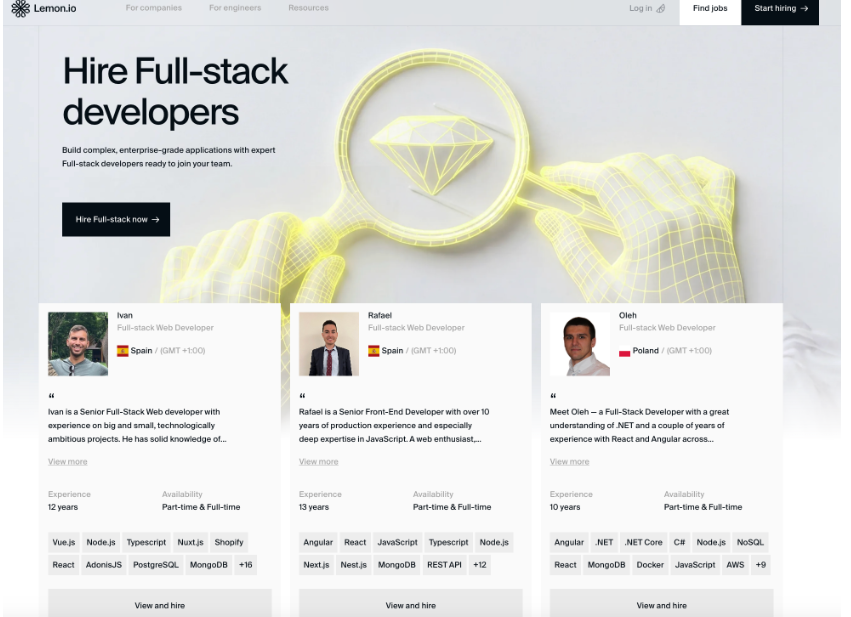
Source: Lemon.io website
Practical Advice on Staff Augmentation, Matched to Your Case
Scenario A. Bridging the full-time hiring gap
Landing a senior backend architect through traditional channels can take two to three months. Rather than stalling critical feature work the whole time, you bring in a senior engineer within days and keep sprint velocity up while your recruiters run the real search for a permanent hire.
Scenario B. Domain-specific technical spikes
Your platform is Node.js and React, but a new feature needs ML model deployment or a gnarly WebSockets integration. Hiring a full-timer for a short-lived spike may bloat payroll. Bring in a vetted contractor, ship the specialized milestone, hand the documentation to your team, and release the resource when it’s done.
Scenario C. Your rapid capacity for launch
A big partner signs, or an enterprise rollout is suddenly on the calendar, and demand goes through the roof. Bring in augmented engineers to handle maintenance, internal tooling, and test coverage, so your core team can focus on the stuff that actually makes or breaks the launch.
What Comes Next? Brief Takeaways for Leaders
At the end of the day, scaling engineering is mainly about matching your team, hiring strategy, and culture to the product’s current stage.
If you take nothing else from this, take these four ideas:
- Match the team to your exact moment. Keep early teams lightweight, flexible, and generalist-led. Bring in narrower specialists after you’ve earned product-market fit.
- Interview for the actual tasks. Better hand people a broken piece of your real codebase and watch them work. Ownership and adaptability in your domain are what you need, along with hard skills that are easier to verify and more general.
- Protect your people from your own mess. Give engineers (especially at after-MVP stages) real authority over technical solutions, wall off sprint time for refactoring before the debt drives them out, and keep showing them how their code moves the business.
- Augment with real-world intent. Keep your core IP in the hands of full-timers, and seek outside help for specialized needs, surge windows, and bridging slow searches for seniors.
Do this deliberately, stage by stage, and you preserve capital, keep the engineers worth keeping, and maintain your delivery speed from the first MVP stage. Do it by accident, and you’ll rebuild the same team three times while your market window closes.
Share:


- What Team Do You Need at Various Product Stages?
- Simple Rules to Avoid Mis-Hire When Requirements Are Blurred
- Establishing a Healthy Work Culture for Keeping Your Top Talent
- When and What to Outsource
- Practical Advice on Staff Augmentation, Matched to Your Case
- What Comes Next? Brief Takeaways for Leaders
Planning to improve development process?
Decrease the entropy of product design and development, and increase your chances of success.


Let’s create a product that finally puts you on the map
Written by


We Help With
Your tech partner needs to be well versed in all kinds of software-related services. As the software development process involves different stages and cycles, the most natural solution is to have them all performed by the same team of experts. That’s exactly what our diverse range of services is for.
The choice of technology for your software project is one of the defining factors of its success. Here at QArea, we have hands-on experience with dozens of popular front-end, back-end, and mobile technologies for creating robust software solutions.
In-depth familiarity and practical experience with key technologies are one of the cornerstones of successful software development and QA. But it also takes specific knowledge of the industry to develop a solution that meets the expectations of the stakeholders and propels its owner to success.


Ensure an effective online presence for your business with a corporate site.