




How Much Does It Cost to Outsource Software Development? 2026 Rates

How much does it cost to outsource software development? Typical provider rates range from $25 to $150+ per hour. A small, tightly scoped app or prototype may cost $20,000-$90,000, a mid-complexity software product may cost $90,000-$250,000, and complex custom software commonly exceeds $250,000. But there is more to know besides bare numbers.
Note that these are market planning ranges rather than fixed quotes: the final cost depends on what the project requires and what the provider includes in its rate.
That wide range is exactly why comparing outsourcing software development costs by hourly rate alone rarely gives you the full picture. Scope, team composition, integrations, AI functionality, security requirements, timeline, engagement model, QA, and project management can influence the total cost as much as the outsourcing destination.
So, after all, how much does outsourced software development cost? This guide breaks down the cost of outsourcing software development by project type, region, role, and pricing model, and explains the hidden costs to account for before you choose the right outsourcing partner.
Key Takeaways
- Outsourced software development typically costs $25-$150+ per hour
- Small projects may cost $20,000-$90,000, while complex products can exceed $250,000
- Region affects rates, but team seniority, scope, and technical complexity often have a greater impact on total cost
- A small outsourced team may cost around $30,000-$70,000 per month
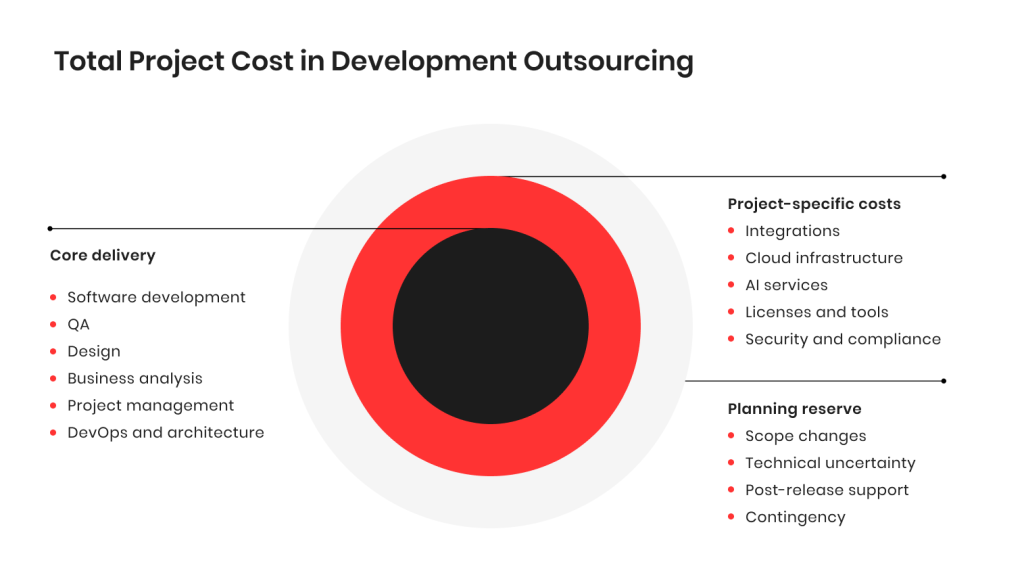
- Estimates should include infrastructure, third-party services, internal oversight, maintenance, and contingency
How Much Does It Cost to Outsource Software Development in 2026?
The cost to outsource software development usually falls between $25 and $150+ per hour, but the hourly rate is only one part of the budget. A small software development project with a narrow feature set may cost $20,000-$90,000. Mid-complexity outsourced software commonly requires $90,000-$250,000, while enterprise platforms, multi-product systems, and technically demanding custom software may exceed $250,000-$500,000. Current industry estimates differ considerably because providers define project complexity and included services differently.
Average project cost by complexity
A simple project generally has one main platform, standard user roles, limited integrations, and straightforward business logic. Mid-complexity products may add a custom backend, several integrations, payment functionality, mobile apps, data processing, or more demanding security requirements. Complex development may involve several platforms, legacy system integration, advanced AI, high-load architecture, strict compliance, or multiple interconnected products.
| Project type | Typical scope | Timeline | Estimated cost |
| Simple product | One platform, core features, few integrations | 2-5 months | $20,000-$90,000 |
| Mid-complexity product | Custom backend, several roles, external services | 5-10 months | $90,000-$250,000 |
| Complex software | Multiple platforms, advanced architecture, compliance | 9-18+ months | $250,000-$500,000+ |
These project cost ranges are market benchmarks, not fixed quotes. Even products that appear similar at first can require very different architecture, QA coverage, infrastructure, and development cycles.
Typical monthly cost of an outsourced development team
A small outsourced development team may cost approximately $30,000-$70,000 per month, depending on location, seniority, and team composition. This planning range could cover two or three developers, a QA engineer, and part-time project management, business analysis, or design support. A larger dedicated development team with senior specialists, DevOps, architecture, and full-time management can cost considerably more.
| Team type | Typical composition | Monthly cost | Best suited to |
| Small product team | 2-3 developers, QA, part-time PM | $30,000-$70,000 | MVPs and smaller products |
| Full product team | 4-6 developers, QA, PM, design support | $60,000-$120,000 | Ongoing product development |
| Specialized team | Senior developers, QA, DevOps, architect | $100,000-$200,000+ | Complex and enterprise systems |
The most reliable estimate therefore starts with the required roles and expected workload, not a single average developer rate. Regional rates, team structure, and included outsourcing services will be explained separately below.

“An hourly rate is only the price of time. The real cost of delivery is determined by how many wrong decisions the team prevents before they turn into months of rework.”
Average Cost of Outsourcing Software Development by Region
Location remains one of the most visible cost factors for onshore, nearshore, and offshore engagements. Outsourcing is generally described as onshore when the provider is in the client’s country, nearshore when the countries are geographically or culturally close, and offshore when the development team works from a more distant outsourcing destination. Offshore software development can offer a lower hourly rate, while onshore and nearshore models often provide more working-hour overlap.
| Region | Typical hourly rate | Time-zone fit | Best suited to |
| North America and Western Europe | $80-$180+ | Strong local overlap | Specialized and regulated projects |
| Eastern Europe | $35-$80 | Europe and partial US overlap | Complex custom software |
| Latin America | $40-$90 | Strong US overlap | Nearshore product teams |
| South and Southeast Asia | $25-$60 | Limited Western overlap | Large-scale offshore development |
| Africa | $25-$65 | Strong European overlap | Focused teams and emerging hubs |
Here are more details about development outsourcing costs by region.
North America and Western Europe
Software development companies in the US, Canada, the UK, and Western Europe typically charge $80-$180+ per hour. Rates can exceed $200 per hour for software architecture, AI, cybersecurity, cloud consulting, or highly regulated development.
Companies usually choose these locations when local market knowledge, legal familiarity, close collaboration, or access to niche expertise matters more than cost reduction. However, assembling a complete development team in these regions can make the total cost difficult for a startup or growing product company to sustain.
Eastern Europe
Typical software development outsourcing rates in Eastern Europe range from approximately $35 to $80 per hour, with senior developers and specialized engineers sometimes billed at higher rates. Established outsourcing markets include Ukraine, Poland, Romania, Bulgaria, Czechia, and the Balkan countries.
Eastern Europe is often selected for complex custom software, SaaS products, enterprise systems, app development, and long-term product engineering. The region combines a substantial technical talent pool with rates below those common in North America and Western Europe. It also offers convenient working-hour overlap for European clients and partial overlap for North American teams.
Stop playing the guessing game — we’ll give you an accurate estimate in 24 hours or less


Latin America
Outsourcing rates in Latin America commonly fall between $40 and $90 per hour, although rates vary considerably across countries and provider types. Brazil, Mexico, Argentina, Colombia, Costa Rica, and Chile are among the region’s established development markets.
Latin America is a particularly practical nearshore option for North American companies. Similar time zones support real-time meetings, collaborative development cycles, and closer integration between the outsourced software team and the client’s in-house team. Growing demand from US companies has also pushed experienced developer rates closer to Eastern European levels.
South and Southeast Asia
South and Southeast Asia generally offer some of the lowest offshore software development rates, commonly around $25-$60 per hour. Senior engineers, AI specialists, architects, and developers working with less common technologies may cost substantially more.
India has the region’s largest outsourcing market, while Vietnam, the Philippines, Bangladesh, Pakistan, Malaysia, and Indonesia provide additional talent pools. The scale of the market gives companies many options, but provider quality, communication practices, seniority, and project management maturity vary widely. Careful vendor assessment is especially important when quotes sit far below the regional average.
Africa
Software outsourcing rates across Africa typically range from $25 to $65 per hour. South Africa, Egypt, Morocco, Kenya, and Nigeria are among the better-known development destinations, although the size and maturity of their outsourcing markets differ.
The region can provide competitive rates, strong English or multilingual communication, and convenient time-zone overlap with Europe. Its senior talent pool is smaller than those of Eastern Europe or Asia, so access to specialized developers may depend heavily on the chosen development partner.
The right outsourcing destination is not necessarily the one with the lowest hourly rate. Communication delays, weak QA, insufficient senior oversight, and expensive rework can erase the initial cost savings. Regional pricing should therefore be considered together with team experience, included services, delivery practices, and the total cost of outsourcing.
Fast project start, accurate estimates, and quality ownership — get it all with QArea

Software Development Outsourcing Rates by Role and Seniority
A software development team is rarely priced at one uniform hourly rate. Each role carries different responsibilities, and rates increase with experience, technical complexity, and decision-making authority. A senior software developer may cost considerably more per hour than a junior developer but often needs less supervision, identifies risks earlier, and completes complex work with fewer revisions.
As a broad global benchmark, junior specialists may be billed at $25-$45 per hour, middle-level specialists at $40-$75 per hour, and senior specialists at $60-$120+ per hour. Solution architects, AI engineers, cybersecurity experts, and other scarce specialists may command $80-$150+ per hour, particularly in higher-cost regions. These ranges overlap because location and provider profile still influence the final rate.
| Role | Junior | Middle | Senior |
| Software developer | $25-$45 | $40-$75 | $60-$120+ |
| QA engineer | $20-$40 | $35-$65 | $55-$100+ |
| UI/UX designer | $25-$45 | $40-$70 | $60-$110+ |
| Business analyst | $30-$50 | $45-$75 | $65-$110+ |
| Project manager | $35-$55 | $50-$85 | $75-$120+ |
| DevOps engineer | $35-$60 | $55-$90 | $80-$135+ |
| AI engineer | $40-$70 | $65-$110 | $90-$150+ |
| Solution architect | — | $70-$110 | $100-$160+ |
A cost-efficient outsourcing team usually combines several experience levels. Senior engineers handle architecture and high-risk decisions, middle developers deliver most functionality, and junior specialists support clearly defined tasks. Other roles may join full-time or only during specific development stages.
When comparing proposals, check:
- Which roles are included
- How much time each specialist will contribute
- Whether QA and project management are billed separately
- Whether architecture, DevOps, and deployment are included
- How the seniority mix affects the total cost
The same developer rate can produce very different outsourcing costs depending on team composition, included services, and delivery responsibilities.
Factors Impacting Outsourcing Software Development Costs
The cost of outsourcing software development depends on much more than location. Scope, technical requirements, team composition, delivery speed, and the outsourcing model all affect the final estimate. These cost drivers also explain why two development companies can quote very different prices for what initially appears to be the same software project.
Project scope and complexity
The number of features, user roles, workflows, integrations, and supported platforms has the greatest impact on development cost. A simple internal tool may require basic authentication and data management, while a customer-facing software product may need payments, real-time updates, analytics, administration tools, and third-party services.
Complex architecture, large data volumes, offline functionality, and high availability also increase the work required across development, QA, DevOps, and project management.
Team size and seniority
A larger team increases monthly outsourcing costs but may shorten the delivery timeline. The right seniority mix matters just as much:
- Senior developers handle architecture and high-risk functionality
- Middle developers deliver most product features
- Junior developers support well-defined tasks
- QA engineers test functionality and reduce release risks
- Architects, DevOps engineers, and analysts join where needed
Using too many junior specialists may create a hidden cost through additional supervision and rework. An unnecessarily senior-heavy development team can make routine tasks more expensive than necessary.
Technology stack and specialized expertise
Projects based on common web and mobile technologies usually provide access to a broader talent pool. Software development rates tend to rise when the work requires scarce or highly specialized skills, including:
- AI and machine learning
- Cybersecurity
- Cloud architecture
- Blockchain
- Embedded systems and IoT
- Legacy software modernization
- High-load data processing
AI features can also increase costs beyond model integration. Data preparation, testing, monitoring, infrastructure, security, and ongoing model management must be included in the estimate.
Platforms and integrations
Building one web application generally costs less than delivering web, iOS, and Android products together. A cross-platform mobile app may reduce some development effort, but it does not remove backend, QA, deployment, and integration work.
External integrations also vary in complexity. Stable, well-documented APIs are usually easier to implement than legacy systems, custom enterprise software, or services with inconsistent data.
Timeline and delivery requirements
A compressed timeline may require more developers, parallel workstreams, additional management, or senior specialists who can make decisions quickly. The project may cost more even when the total scope remains unchanged.
Unclear requirements can also extend development cycles through repeated clarification, redesign, and scope changes.
Security, compliance, and documentation
Products in healthcare, finance, government, and other regulated industries require additional security controls, testing, documentation, and audit support. Accessibility, data residency, privacy, and industry-specific requirements may influence the cost of outsourcing from the discovery stage through deployment.
Documentation, automated tests, and structured knowledge transfer also add effort, but excluding them can make future maintenance and vendor transition significantly more expensive.
Outsourcing partner and engagement model
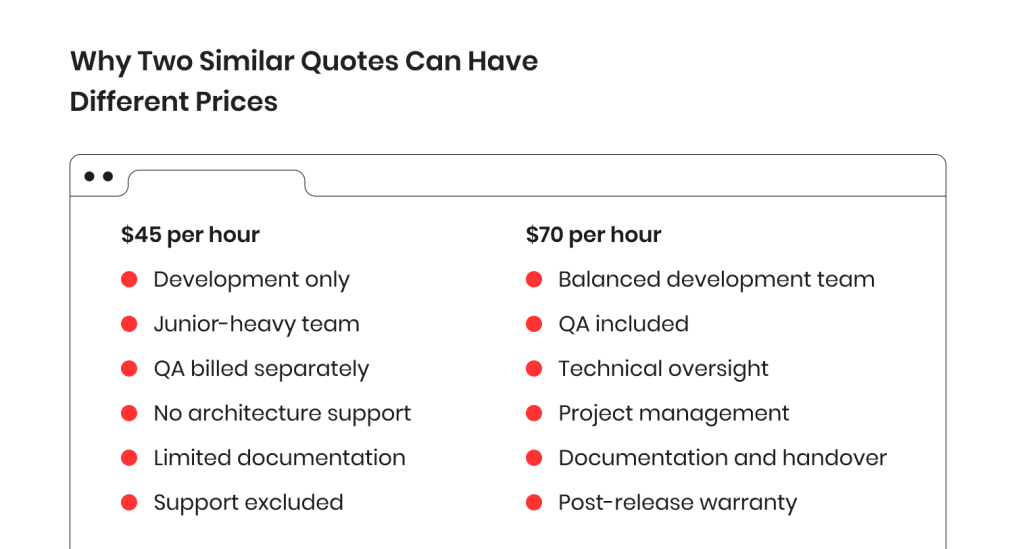
Provider size, specialization, location, and delivery maturity all influence the hourly rate. A higher rate may include experienced management, QA, technical oversight, recruitment, equipment, and commercial risk, while a lower quote may cover development work only.
The chosen engagement model also affects cost predictability. Fixed-price projects place more estimation risk on the provider, while time and material and dedicated team arrangements give the client more flexibility as requirements change.
Software Development Outsourcing Pricing Models
The engagement model determines how the work is planned, billed, and adjusted during delivery. It also affects cost predictability, flexibility, and how financial risk is shared between the client and the outsourcing partner.
| Model | Billing approach | Best suited to | Main budget risk |
| Fixed price | Agreed project budget | Stable and defined scope | Changes cost extra |
| Fixed price+ | Different models by project stage | Projects with changing delivery needs | Requires clear stage planning |
| Time and material | Actual hours worked | Changing requirements | Less predictable total |
| Dedicated team | Monthly team cost | Long-term product development | Underused capacity |
| Staff augmentation | Individual specialist rates | Skill and capacity gaps | Client manages delivery |
Fixed price
A fixed-price model sets an agreed budget for a defined scope, timeline, and set of deliverables. It works best for smaller projects with stable requirements, clear acceptance criteria, and few expected changes.
The provider usually includes a risk margin in the estimate, while significant scope changes require separate approval and pricing. Fixed price offers predictability but can become restrictive when priorities shift during development. QArea also offers Fixed Price+, which allows different engagement models to be used at different stages of the same project.
Time and material
With time and material, the client pays for the actual hours worked at agreed rates. This model is suitable for software products with changing requirements, ongoing discovery, or a roadmap that will be refined during development.
It provides more flexibility than fixed price, but the total project cost is less predictable. Regular planning, transparent reporting, and budget checkpoints are essential for keeping outsourcing costs under control.
Dedicated team
A dedicated development team is assigned to one client for an extended period and is usually billed monthly. The team may include developers, QA engineers, designers, DevOps specialists, analysts, and project management.
This outsourcing model works well for long-term product development, frequent releases, and projects that require stable product knowledge. It provides consistent capacity but requires enough ongoing work to keep the team fully engaged.
Staff augmentation
Staff augmentation allows a company to hire individual specialists who join its existing software development team. The client usually manages priorities, workflows, and technical decisions, while the outsourcing company handles employment and administrative responsibilities.
This model is useful for filling skill gaps, increasing delivery capacity, or adding temporary expertise. Its cost efficiency depends heavily on the client’s ability to manage the added specialists.
Not sure which model is right for your project?
A 30-minute call with our Delivery Director will give you the answer.

Hidden Costs of Outsourcing Software Development
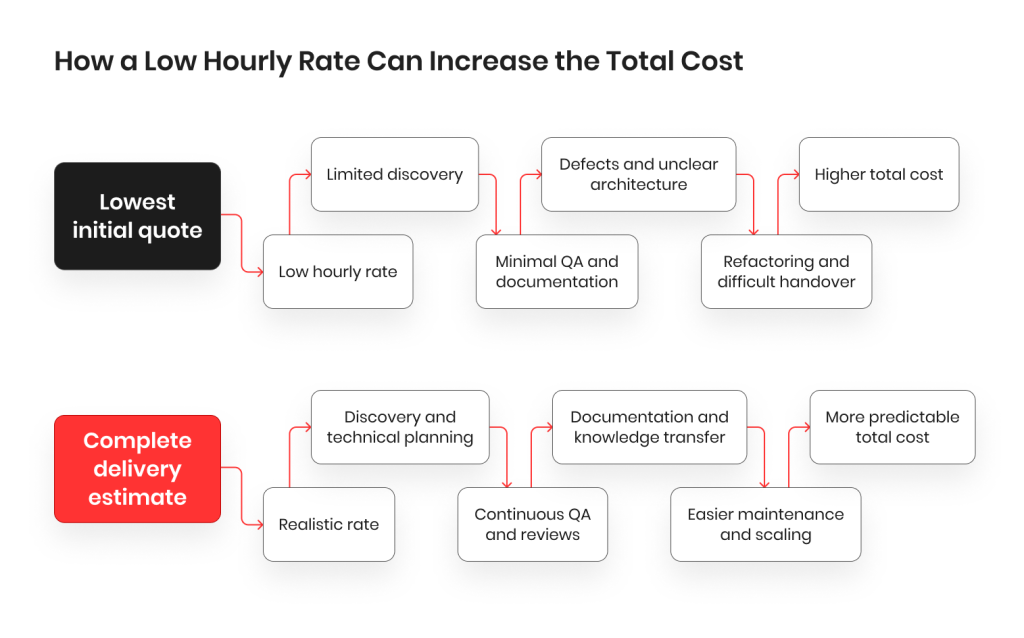
The quoted hourly rate rarely represents the total cost of outsourcing. A proposal may cover development work but exclude discovery, infrastructure, QA, change requests, support, or internal management. These additional expenses are not always signs of poor planning; many arise because the product changes or technical risks become clearer during delivery.
Discovery and requirement clarification
Projects with incomplete requirements usually need workshops, technical research, prototyping, or architecture planning before development begins. Skipping this stage may reduce the initial estimate but increase the risk of rework later.
Client-side management
An outsourcing partner can provide project management, but the client still needs someone to set priorities, answer business questions, review progress, and approve decisions. The time spent by product owners, executives, legal teams, and internal engineers belongs in the total cost of outsourcing.
Scope changes and delayed decisions
New features, changed workflows, or late feedback can affect both budget and timeline. Delays on the client side may also leave parts of the outsourcing team blocked while costs continue to accumulate.
QA and technical rework
Testing may be included in the team structure, billed separately, or left largely to developers. Weak QA, insufficient technical oversight, and rushed delivery can create a much larger hidden cost after release through bug fixing, refactoring, and lost user trust.
Infrastructure and third-party services
The development estimate may not include:
- Cloud hosting and data storage
- Paid APIs and AI services
- Development and testing tools
- App store and platform fees
- Security monitoring
- Software licenses
- Test devices and environments
These costs may remain modest during development but increase as usage grows.
Documentation and knowledge transfer
“Documentation is the product’s passport. Without it, the software may run, but it cannot travel safely — to a new team, a new market, or the next stage of growth.”
Missing documentation can make future maintenance, onboarding, and vendor transition slower and more expensive. The project should include enough technical documentation, automated tests, setup instructions, and code ownership information for another qualified team to continue the work.

Strong QA, documentation, and technical oversight increase the visible project budget but can reduce maintenance and handover costs. Cutting these areas often moves expenses to a later stage instead of removing them.
Maintenance after deployment
A software product continues to generate costs after launch. Hosting, monitoring, security updates, bug fixes, compatibility changes, and ongoing feature development should be included in long-term planning.
A complete estimate should clarify what is included in the hourly rate, what is billed separately, and which costs remain the client’s responsibility. The lowest initial quote may produce a higher total cost when essential delivery activities are excluded.
Software experts often warn that a low initial rate can become expensive when the delivered product lacks documentation, automated tests, consistent architecture, or clear code ownership. The cost typically appears later through slower feature development, extensive refactoring, difficult handover, and dependence on the original provider.
Outsourcing vs. In-House Software Development Cost
Comparing outsourcing with an in-house team requires more than placing an employee salary next to a vendor’s hourly rate. Internal development includes recruitment, payroll taxes, benefits, equipment, software, management, training, and periods when specialists are not fully utilized. An outsourcing partner usually combines many of these expenses into one commercial rate.
| Cost category | In-house team | Outsourced team | Main implication |
| Recruitment | Paid by the company | Usually included | Outsourcing starts faster |
| Salaries and taxes | Direct ongoing cost | Included in provider rate | Vendor rate looks higher |
| Benefits and equipment | Company responsibility | Usually included | Fewer separate expenses |
| Team management | Fully internal | Shared or provider-led | Client ownership still required |
| Scaling | Slow and expensive | Usually faster | Capacity is easier to adjust |
| Idle capacity | Paid by the company | Often adjustable | Better for changing workloads |
| Knowledge retention | Stronger internally | Requires documentation | Handover must be planned |
| Commercial margin | None | Included in the rate | Covers operations and delivery risk |
When outsourcing may cost less
Outsourcing your software development project can improve cost efficiency when the business needs to:
- Start development without a lengthy hiring process
- Access specialists for a defined period
- Scale the development team up or down
- Deliver a product without building every capability internally
- Cover temporary demand or accelerate an existing roadmap
- Enter a new technology or product area
This model is often practical for a startup, a time-sensitive software project, or a company that needs AI, cloud, QA, security, or mobile app expertise without hiring permanent employees for every role.
Outsourcing can save time and provide faster access to specialists, even when the direct cost difference is smaller than expected. For many companies, delivery speed and hiring flexibility matter as much as the hourly rate.
When an in-house team may offer better value
Internal hiring may be more cost-effective when the company has stable long-term workloads, strong technical management, and enough ongoing work to keep the team fully occupied. It can also support closer product ownership, faster access to internal stakeholders, and stronger long-term knowledge retention.
Outsourcing does not remove the need for client involvement. Someone within the company must still own priorities, provide domain knowledge, review results, and make product decisions.
The better option depends on the total cost, not the lowest visible rate. Many companies use a hybrid approach: a core in-house team retains product knowledge while an outsourcing team adds capacity or specialized expertise where needed.
How to Estimate and Reduce Software Outsourcing Costs
A reliable estimate starts with the work the software development team must complete, not with a single hourly rate. The same rate can lead to very different project costs depending on scope, team composition, delivery speed, and the amount of work included outside coding.
A simple outsourcing cost formula
Use this formula for early budget planning:
For example, the calculation should account for developers, QA, design, business analysis, project management, DevOps, and architecture where required. Cloud services, paid integrations, AI tools, licenses, and post-release support may need separate budget lines.
Estimated project cost = role-based hourly rates × estimated hours + infrastructure and third-party costs + contingency + internal oversight
This formula provides a planning range rather than a final quote. Outsourcing software development depends on technical discovery, confirmed requirements, delivery risks, and the chosen engagement model.
How to reduce costs without creating technical debt
The goal should not be to cut costs at every stage. It is to remove unnecessary work while protecting product quality and maintainability.
- Start with a prioritized MVP or phased roadmap
- Define user flows and acceptance criteria before development
- Use a balanced mix of junior, middle, and senior specialists
- Include QA early instead of testing only before release
- Reuse reliable components where custom development adds little value
- Review architecture and code quality throughout the project
- Track scope changes and their budget impact
- Require documentation, automated tests, and clear code ownership
- Reserve a contingency budget for technical uncertainty
- Avoid choosing an outsourcing partner based only on the lowest rate
A smaller first release can reduce development cost and help the team test important product assumptions before investing in secondary functionality. However, removing security, QA, documentation, or technical planning often creates a higher hidden cost later.
Questions to ask before accepting a quote
Before choosing the right outsourcing partner, clarify:
- Which roles and seniority levels are included
- Whether QA and project management are part of the estimate
- How scope changes are approved and billed
- Which infrastructure and third-party costs are excluded
- Who owns the source code and project documentation
- What support is available after deployment
- How progress, hours, and budget are reported
- Whether the proposed outsourcing model can change between project stages
A trustworthy development partner should explain the assumptions behind the estimate, the main cost drivers, and the situations that could increase the total cost. This makes it easier to compare proposals on delivery scope and risk, not only on the advertised cost per hour.

Get a Realistic Outsourcing Cost Estimate With QArea
Market ranges are useful for early planning, but a reliable estimate requires a closer look at your product scope, platforms, integrations, technical constraints, timeline, and expected team structure.
QArea can help you assess outsourcing your software development project and prepare a preliminary estimate that covers:
- Recommended team composition
- Role-based software development rates
- Delivery assumptions
- Expected timeline
- Suitable engagement model
- Main technical and budget risks
- Costs that may fall outside the initial development scope
This gives you a clearer view of the likely project cost before you commit to a full development plan.
FAQ
 How much does it cost to outsource software development in 2026?
Typical rates range from $25 to $150+ per hour. A small project may cost $20,000-$90,000, mid-complexity software $90,000-$250,000, and complex custom software $250,000-$500,000+.
What is the average hourly rate for outsourced software development?
Most outsourcing companies charge around $25-$150+ per hour. Rates depend on region, role, seniority, technology, and included services. AI engineers, architects, and cybersecurity specialists may cost more.
How much does a dedicated development team cost per month?
A small dedicated team may cost approximately $30,000-$70,000 per month. Larger teams with senior developers, QA, DevOps, architecture, design, and full-time project management can cost considerably more.
Is outsourcing software development cheaper than hiring in-house?
It often is when a company needs faster hiring, temporary capacity, or specialized expertise. The comparison should include recruitment, salaries, taxes, benefits, equipment, management, and idle capacity, not only employee salaries and vendor rates.
Which outsourcing destination offers the lowest rates?
South and Southeast Asia and parts of Africa generally offer the lowest hourly rates. Eastern Europe and Latin America often cost more but may provide stronger time-zone compatibility, senior expertise, or easier collaboration.
Share:


- Key Takeaways
- How Much Does It Cost to Outsource Software Development in 2026?
- Average Cost of Outsourcing Software Development by Region
- Software Development Outsourcing Rates by Role and Seniority
- Factors Impacting Outsourcing Software Development Costs
- Software Development Outsourcing Pricing Models
- Hidden Costs of Outsourcing Software Development
- Outsourcing vs. In-House Software Development Cost
- How to Estimate and Reduce Software Outsourcing Costs
- Get a Realistic Outsourcing Cost Estimate With QArea
Planning to improve development process?
Decrease the entropy of product design and development, and increase your chances of success.

Share Your Project Details
And we’ll come back with an estimate in under 24 hours.
Written by



We Help With
Your tech partner needs to be well versed in all kinds of software-related services. As the software development process involves different stages and cycles, the most natural solution is to have them all performed by the same team of experts. That’s exactly what our diverse range of services is for.
The choice of technology for your software project is one of the defining factors of its success. Here at QArea, we have hands-on experience with dozens of popular front-end, back-end, and mobile technologies for creating robust software solutions.
In-depth familiarity and practical experience with key technologies are one of the cornerstones of successful software development and QA. But it also takes specific knowledge of the industry to develop a solution that meets the expectations of the stakeholders and propels its owner to success.


Ensure an effective online presence for your business with a corporate site.