




Mental Health App Development: How to Create an App Users Can Trust
The mental health app market is already big, but it is far from settled. In 2026, the global mental health apps market is projected to reach $9.6 billion, with forecasts pointing to $40.9 billion by 2035. That growth creates room for new products, but only if they solve a clear mental health problem better than another generic mood tracking or meditation tool.
For founders, mental health app development usually starts with three hard questions:
- Is there space for my idea?
- What should the first version include?
- Who can build it safely and well?
Creating a mental health app means answering those questions before the first sprint, because the product will deal with sensitive users, private health data, emotional states, and, in many cases, regulations that are specific to healthcare software.
A strong mental health application does not need to launch with every possible feature. It needs the right target audience, focused core features, reliable data security, and a user experience that makes people feel understood without overwhelming them. This guide explains how to create a mental health app from idea to MVP and beyond, what mental health app features matter most, how to develop a mental health app with the right team, and where founders can still find space in the mental health app market.
Key Takeaways
- A strong mental health app starts with one audience, one problem, and one measurable outcome.
- Users leave mental health apps when tracking, reminders, or content do not create daily value.
- AI can improve personalization, but it needs clear limits, review, and safe escalation logic.
- Data privacy is part of the product experience, not only a backend requirement.
- Early user feedback should decide the roadmap faster than internal assumptions.
- AI-powered development can make a lean MVP more affordable when the scope is tightly controlled.
Is There Still Room for a New Mental Health App?
Yes, but only if the product has a clear reason to exist.
The mental health app market already has strong players in meditation, therapy access, mood tracking, and daily mental wellness. A new mental health app does not need to compete with all of them at once. It needs to solve a specific problem for a specific target audience better than the broad tools they already know.
That space can come from focus:
- A mental health app for students managing anxiety before exams.
- A mental wellness product for remote teams at risk of burnout.
- A therapy companion for users between therapy sessions.
- A mood tracking tool for people managing chronic disease and stress.
- A mindfulness app built around short daily routines for busy parents.
- A digital health solution that helps clinics keep users engaged between appointments.
The strongest mental health apps usually start with one sharp use case, not a large feature set. This makes the first version easier to build, test, explain, and improve after early user feedback. Here are the most promising mental health app opportunities by focus area.
| Focus area | User need | Product angle |
| Student mental health | Exam stress, anxiety, sleep issues | Short check-ins, breathing exercises, study support |
| Workplace wellness | Burnout, stress, low engagement | Private routines, stress tracking, team-level insights |
| Therapy support | Gaps between therapy sessions | Mood tracking, journaling, progress reports |
| Chronic condition support | Mood, pain, sleep, and daily life patterns | Combined health and mood tracking |
| Mindfulness routines | Quick stress relief | Guided meditations, reminders, breathing tools |
| Clinic engagement | Support between appointments | Secure messaging, care plans, appointment scheduling |
Where generic mental health apps lose users
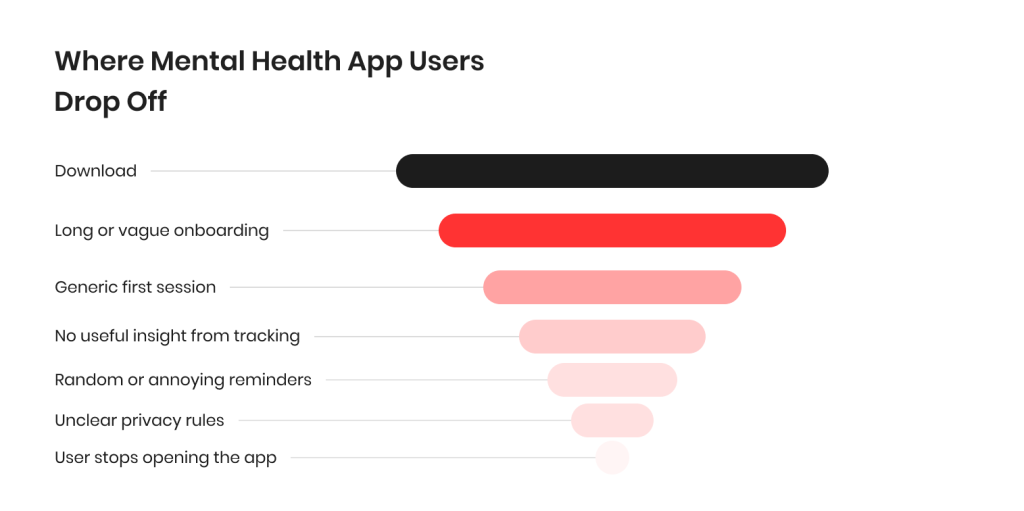
Generic mental health apps often fail because they feel useful on day one and forgettable by week two. Common reasons include:
- Vague positioning: Users do not understand whether the app is for anxiety, stress, mood tracking, meditation, therapy support, or general mental wellness.
- Too much friction: Long onboarding, too many questions, or complex setup can push users away before they see value.
- Weak daily value: Mood tracking without insights, journaling without prompts, or meditation libraries without guidance can feel like homework.
- Low trust: Users may hesitate to share health data if privacy, encryption, and data storage are unclear.
- Poor timing: Notifications can feel random, intrusive, or disconnected from the user’s actual mental health journey.
- No human backup: Some users need a way to connect with a professional, book therapy sessions, or get directed to appropriate care.
- Thin personalization: If every user gets the same content, reminders, and progress tracking, the app quickly feels generic.
This is why mental health app development should start with behavior, not features. What does the user feel before opening the app? What do they want to do in two minutes? What would make them come back tomorrow?
How to find your spot in the mental health app market
To find a real opening, narrow the idea until it becomes easy to describe.
Here is a useful test you can use before taking the next step:
“We help [specific users] manage [specific mental health problem] through [specific product approach].”
For example:
- We help first-time founders manage stress through daily check-ins and short breathing exercises.
- We help therapists support clients between sessions with mood tracking, journaling, and progress tracking.
- We help people with chronic conditions identify how pain, sleep, and mood affect daily life.
- We help employers offer private, low-pressure mental wellness support to distributed teams.
Before developing a mental health app, define five things:
| Question | Why it matters |
| Who is the app for? | Shapes design, tone, features, and compliance needs. |
| Which problem does it solve first? | Keeps the MVP focused. |
| When will users open it? | Helps define daily flows and user engagement. |
| What data will it collect? | Affects data privacy and security planning. |
| What support level is needed? | Defines whether you need self-guided tools, AI, professional support, or healthcare integration. |
This approach also helps you decide what not to build yet. A focused mental health application can launch with basic features, gather feedback, and add more advanced mental health app features only when users prove they need them.
Let’s build the future of digital mental care together


Main Types of Mental Health Applications You Can Develop
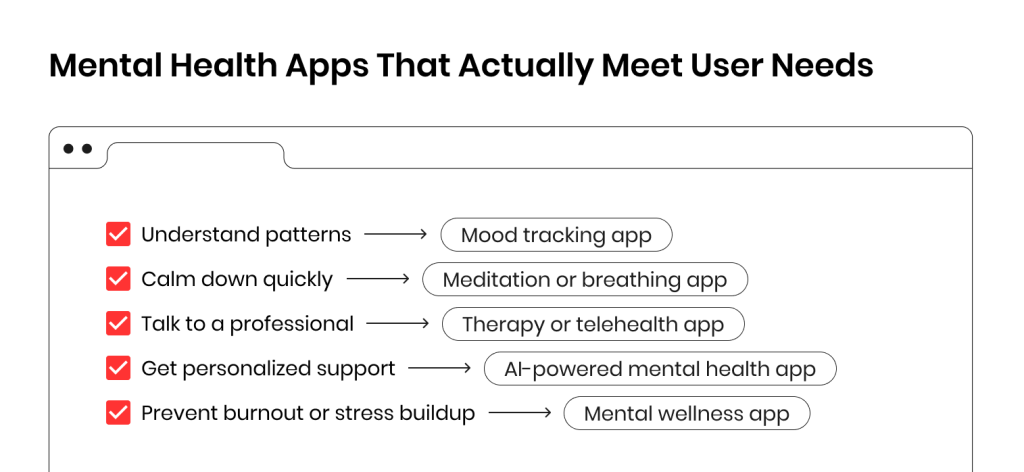
Before starting mental health app development, it’s crucial to define the product type. It will shape the feature set, technology stack, design, compliance needs, and development team structure. Most mental health applications fall into one of five groups, and here is a closer look at each one.
Mood tracking and progress tracking apps
These mental health apps help users notice patterns in mood, sleep, stress, symptoms, habits, and daily triggers.
Common features include:
- Mood tracking
- Journaling
- Trigger logs
- Goal setting
- Progress tracking
- Charts and insights
- Reports for therapy sessions
This type of mental health app works best when data leads to useful feedback. A simple “How do you feel today?” check-in is not enough unless users can identify patterns and understand what to do next.
Meditation and mindfulness apps
Meditation and mindfulness apps focus on self-guided support for stress, anxiety, focus, sleep, and emotional balance.
Common features include:
- Guided meditations
- Breathing exercises
- Sleep stories or sounds
- Short daily practices
- Mindfulness programs
- Progress reminders
These mental health apps need simple navigation, strong content quality, and flexible session lengths. Many users open them when they are tired, stressed, or short on time, so the user experience should feel light from the first tap.

“To minimize cognitive load, the app should also make use of wearable integrations like Apple Health and Google Fit, as well as automated mood tracking. The goal is to gather insights like sleep patterns or activity levels without forcing the user to type or fill out long questionnaires.”
Therapy and telehealth apps
Therapy and telehealth apps connect users with licensed professionals or support hybrid mental health care.
Common features include:
- Therapist profiles
- Appointment scheduling
- Secure chat
- Video therapy sessions
- Post-session feedback
- Community ratings
- Payments
- Health insurance support
- Provider dashboards
- Care notes
This type of mental health application has higher security, privacy, and regulatory requirements. It may also require healthcare integration, identity verification, encrypted communication, and stronger management tools for providers.
AI-powered mental health apps
AI can support personalization, content recommendations, mood insights, journaling prompts, and early pattern detection.
Common features include:
- AI chat support
- Personalized recommendations
- Mood pattern analysis
- Machine learning-based insights
- Smart reminders
- Content matching
- Risk flagging for human review
AI-powered development needs careful boundaries, especially in mental health products. Artificial intelligence can support the mental health journey, but it should not replace professional care or make unsupported clinical claims.
Mental wellness and prevention apps
Mental wellness and prevention apps help users manage daily stress before it grows into a bigger problem.
Common features include:
- Stress check-ins
- Burnout prevention tools
- Habit tracking
- Breathing exercises
- Mindfulness content
- Private team wellness programs
- Daily emotional health routines
These products often work well for startups, employers, schools, and communities that want a lighter digital health solution. The main challenge is user engagement: the app has to fit naturally into daily life, not become another task users feel guilty about skipping.
How to Develop a Mental Health App: From an Idea to an MVP and Beyond
Mental health app development works best when product decisions come before engineering decisions. Before choosing frameworks, AI tools, or cloud services, define what problem the mental health app solves, who it supports, and what “useful” means for the first version. Here is how to go from a product idea to a fully functioning app.
1. Define the problem, target audience, and goals
Start by turning the idea into a clear product statement. For example:
- Students managing exam anxiety through short check-ins and breathing exercises.
- Therapy clients tracking mood and progress between therapy sessions.
- Remote employees managing stress and burnout through private daily mental wellness routines.
- People with chronic conditions connecting mood, sleep, pain, and daily habits.
This step should define:
- Primary users: Who will open the app and why?
- Core problem: Anxiety, stress, mood changes, therapy support, mindfulness, burnout, mental wellness, or another focus.
- Product goal: Self-care, professional support, progress tracking, prevention, or hybrid care.
- Success metric: Retention, completed check-ins, booked sessions, improved engagement, or user-reported progress.
- Risk level: Whether the app provides wellness content, clinical support, AI guidance, or healthcare integration.
The narrower this foundation is, the easier it becomes to create a mental health app users understand quickly.
2. Research users, competitors, and clinical expectations
Research should answer one question: what would make users trust this product enough to return?
Useful research sources include:
- Interviews with target users
- App Store and Google Play reviews
- Competitor analysis
- Reddit and community discussions
- Therapist or coach input
- Healthcare and digital health regulations
- Existing clinical workflows, if the app supports professionals
Look for patterns in what users complain about:
- Onboarding feels too long
- Notifications feel pushy
- Mood tracking does not lead to insights
- Content feels generic
- Privacy is unclear
- AI responses feel shallow or unsafe
- Therapy access is expensive or inconvenient
- The app is abandoned after the first week
This research should shape the mental health app development plan. If users want privacy and quick relief, the process of MVP development should not start with a complex dashboard. If therapists need progress reports, the product should make tracking and sharing simple from the beginning.
3. Define core features for the first version
The first version should be small enough to launch, but complete enough to prove value. A mental health app MVP should cover one main user journey from start to finish:
- Self-guided mental wellness MVP: can include mood tracking and breathing exercises to help users manage daily stress or anxiety.
- Therapy or telehealth MVP: can include appointment scheduling and secure chat to connect users with professionals.
- AI-powered mental health app MVP: can include AI journaling prompts and mood pattern summaries to make self-reflection more personal.
- Meditation or mindfulness MVP: can include guided meditations and personalized reminders to support short daily routines.
- Progress tracking MVP: can include goal setting and basic insights to help users understand changes over time.
A useful rule: every MVP feature should answer one of three questions:
- Does it help users start?
- Does it help users return?
- Does it help users feel safer or better supported?
Everything else can wait.
4. Design user experience around emotional states
Mental health app design is different from many other health applications because users may open the product while feeling anxious, tired, stressed, distracted, ashamed, or overwhelmed. And that affects every design choice.
In order for a new app to succeed, it’s crucial to keep the user experience:
- Low-friction: Short onboarding, clear next steps, minimal typing.
- Calm: Simple screens, readable text, no visual overload.
- Flexible: Users should be able to skip, pause, edit, or change goals.
- Private: Privacy settings should be easy to find, not buried.
- Supportive: Use plain, respectful language.
- Actionable: Insights should lead to simple next steps.
Examples:
- Instead of asking users to fill in a long mental health profile on day one, ask only what is needed to personalize the first session.
- Instead of showing complex mood charts immediately, show one useful pattern after enough data is collected.
- Instead of fixed daily reminders, let users choose timing, tone, and frequency.
- Instead of making progress feel like a streak users can “lose,” frame it as patterns, consistency, and self-awareness.
This is where mental health app developers, UX designers, and domain experts need to work together. Good design can reduce drop-off, but in mental health care, it also affects trust.
“For mental health apps, low friction is part of the product value. Users should not feel like they have been given another task to manage. Smart wearable sync, one-tap mood logging, and contextual insights based on passive data can make the experience easier to maintain, especially for people who are already tired, anxious, or overwhelmed. The less effort the app requires, the more likely it is to become genuinely supportive rather than just another unused wellness tool.”
5. Choose the technology stack and architecture
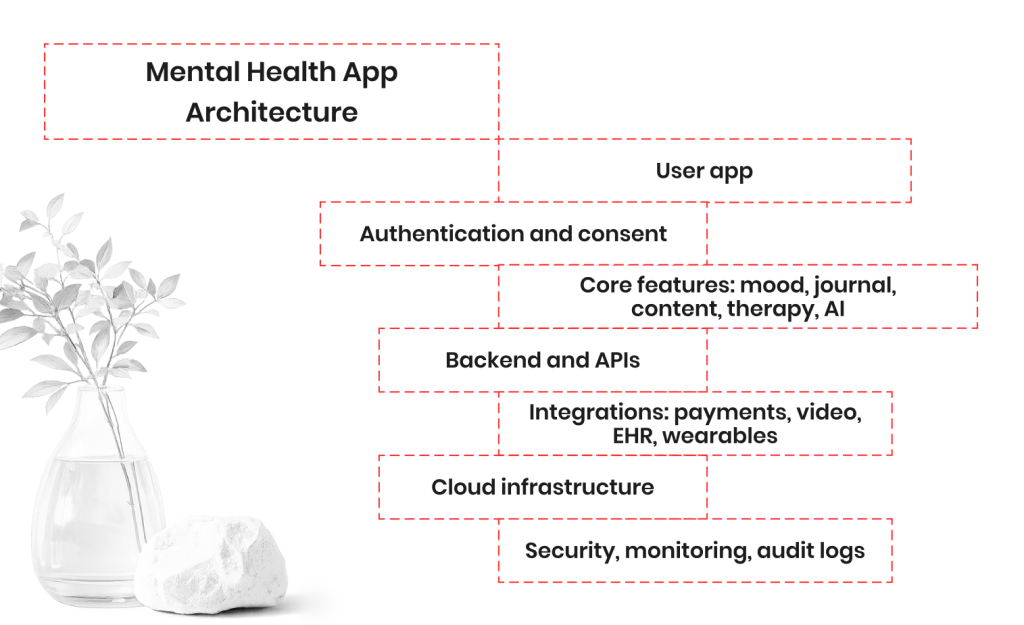
The technology stack should match the product model, not the other way around. A meditation app, AI journaling tool, and telehealth platform have different architecture needs.
Key decisions include:
- Mobile approach: Native iOS/Android, React Native, or Flutter.
- Backend: Node.js, .NET, Python, Java, or another scalable backend.
- Cloud: AWS, Azure, or Google Cloud with secure data storage.
- Database: Structured storage for profiles, logs, sessions, and app content.
- AI/ML layer: Machine learning models, recommendation systems, or NLP tools.
- Integrations: Payments, calendars, EHR, wearables, video calls, health insurance systems.
- Analytics: Product analytics that respect privacy and avoid unnecessary data collection.
- Security: Encryption, access control, audit logs, and secure APIs.
Architecture should also reflect compliance needs. A mental health application that stores therapy notes, health records, or protected health data needs stronger controls than a general mindfulness app.
6. Build, test, launch, and improve with early user feedback
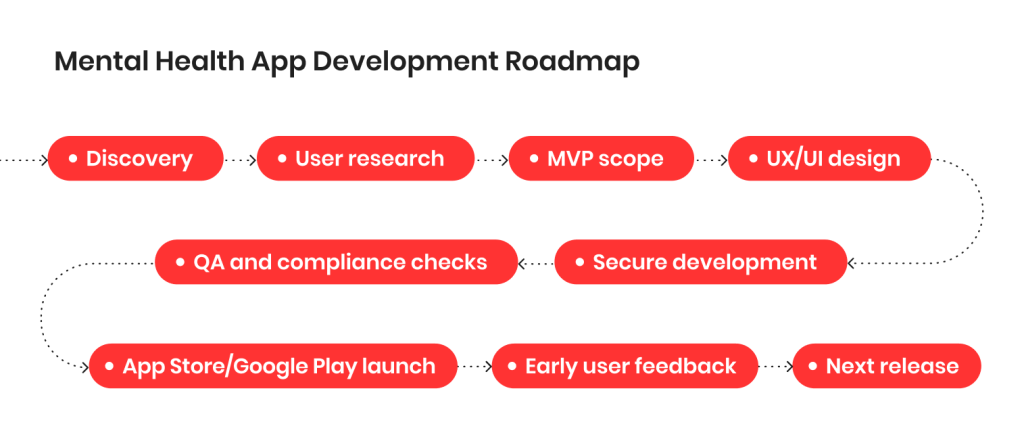
Once the scope is clear, the development team can move into delivery: design, development, QA, release preparation, and post-launch improvement.
A strong app development process usually includes:
- Product backlog creation
- UX/UI design
- Architecture planning
- Mobile and backend development
- API and integration work
- QA testing
- Security testing
- Compliance review
- App Store and Google Play preparation
- Beta testing
- Launch support
- Post-launch monitoring
Testing is especially important in mental health app development. The team should check more than whether the buttons work. Focus testing on:
- Onboarding flow
- Mood tracking accuracy
- Notification behavior
- Data encryption
- User permissions
- Payment or scheduling flows
- Video/session stability
- AI feature boundaries
- Accessibility
- Performance under load
- App behavior after failed connections or interrupted sessions
After launch, early user feedback should guide the next version. Look at where users drop off, which features they return to, what they ignore, and what support requests reveal. The goal here is not to build every planned feature quickly. The goal is to create a mental health app that earns trust, proves demand, and grows through careful product decisions.
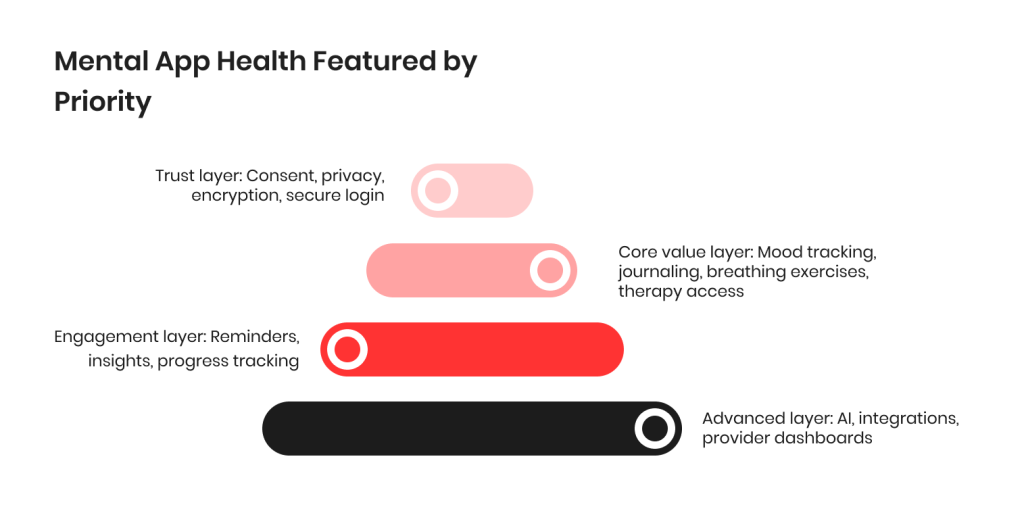
Mental Health App Features That Users Actually Need
A feature-rich mental health app is not always a better product. For the first version, focus on features that help users start easily, return regularly, protect their health data, and get the right level of support. Here is a breakdown of features users actually want to see in their mental health apps.
Basic features
Basic features create the first layer of trust and usability. They usually include:
- Simple onboarding
- Account registration
- User profile
- Consent forms
- Privacy settings
- Notification preferences
- Content library
- Search and filters
- Accessibility settings
For mental health apps, onboarding should be short and calm. Ask only for information the product truly needs. If the app collects sensitive health data, explain why it is needed and how it will be protected.
Engagement features
Engagement features help users return without feeling pressured. Useful options include:
- Mood tracking
- Daily check-ins
- Journaling prompts
- Goal setting
- Progress tracking
- Personalized reminders
- Guided meditations
- Breathing exercises
- Stress and anxiety logs
- Simple insights
The best engagement features connect daily actions with visible progress. For example, mood tracking becomes more valuable when users can identify patterns between sleep, stress, work, symptoms, and life events.
Clinical and professional features
Clinical features are needed when a mental health application connects users with therapists, coaches, clinics, or care teams. These may include:
- Therapist profiles
- Appointment scheduling
- Secure messaging
- Video therapy sessions
- Session notes
- Treatment plans
- Provider dashboards
- User progress reports
- Payments
- Health insurance integration
This part of mental health app development requires extra care. Any feature connected to therapy sessions, professional advice, or health records may affect regulatory compliance, data storage, access control, and security measures.
AI features
AI features can make a mental health app more personal and responsive, especially when the product has enough user context. Possible AI features include:
- Smart journaling prompts
- Mood pattern detection
- Personalized content suggestions
- AI-based reminders
- Chat support
- Sentiment analysis
- Machine learning insights
- Risk flagging for human review
AI should be used with clear limits. It can support reflection, personalization, and user engagement, but it should not make clinical decisions, replace professional care, or respond to serious situations without a safe escalation path.
Security and compliance features
Security features are core features in mental health app development, not technical extras. A safe mental health app should include:
- Data encryption
- Secure login
- Multi-factor authentication
- Consent management
- Role-based access
- Audit logs
- Secure APIs
- Encrypted data storage
- Data deletion options
- GDPR-ready privacy controls
- HIPAA-ready architecture where required
“Feedback systems in mental health and healthcare apps need careful privacy design. In the US and the EU, regulations such as HIPAA and GDPR affect how patient feedback, provider reviews, and care-related comments can be collected, stored, and displayed. Even a simple doctor rating flow can expose sensitive context if it is not designed properly, so privacy, consent, moderation, and compliance checks should be part of the development process from the start.”
Users need to understand what data the app collects, who can access it, and how they can control it. Clear privacy design is especially important for mental health applications because users may share mood history, personal notes, therapy details, stress triggers, and other sensitive health data.
Challenges in Mental Health App Development and How to Solve Them
Mental health app development comes with product, trust, compliance, and technical risks. The safest approach is to plan for them before the MVP stage, not after launch. These are the most common challenges you can encounter, what kind of risk they create for the project, and how to mitigate them effectively.
| Challenge | Risk | Solution |
| Unclear niche | Hard to position and sell | Focus on one audience, one problem, and one outcome |
| Low user engagement | Users leave after a few sessions | Use short check-ins, useful insights, and flexible reminders |
| Weak trust | Users hesitate to share health data | Make consent, privacy settings, and data use clear |
| Clinical risk | Content may affect care decisions | Involve experts for therapy or symptom-related flows |
| AI safety | AI may give unsuitable responses | Set limits, review outputs, and add human escalation |
| Compliance complexity | Architecture may need rework | Define markets, data types, and regulations early |
| Integration issues | Delivery slows and costs rise | Prioritize only launch-critical integrations |
How Much Does It Cost to Develop a Mental Health App?
The cost to develop a mental health app depends on scope, platforms, design complexity, integrations, compliance needs, and team location. A simple MVP with mood tracking, journaling, reminders, and basic progress tracking will cost less than a mental health application with AI, therapy sessions, provider dashboards, EHR integration, and advanced security.
Main cost drivers include:
- Feature set: Basic features, engagement tools, clinical workflows, or AI features.
- Platform choice: iOS, Android, cross-platform, or web.
- Compliance: GDPR, regulations like HIPAA, consent management, audit logs, and secure data storage.
- Integrations: Payments, video calls, calendars, wearables, health insurance, or healthcare systems.
- Post-launch work: Bug fixes, cloud costs, security updates, analytics, and new feature releases.
For founders, the safest approach is to start with a focused MVP, gather feedback, and expand only after users prove which mental health app features matter most. This is the approach we often recommend to startups interested in mental health or fitness app development that want to get results fast and on a reasonable budget.
With AI-powered development workflows, a focused mental health app MVP can sometimes be built for around $10K, especially if the first version uses a lean feature set, cross-platform development, ready-made components, and a clear product scope. This works best for early validation: enough to test the idea, gather user feedback, and decide whether to invest in advanced AI features, therapy sessions, healthcare integration, or deeper compliance work.
Our Approach to Mental Health Development
Our approach to mental health app development is built around one goal: help founders launch a focused, safe, and credible product without overbuilding the first version.
In our work, we prioritize five principles:
- Start narrow. Choose one target audience, one core mental health problem, one clear MVP path.
- Design for trust. Calm UX, transparent consent, visible privacy controls, and respectful language.
- Build security in early. Data encryption, secure data storage, access control, and compliance planning from the first architecture decisions.
- Use AI carefully. AI-powered development can speed up delivery, but AI product features need clear limits, review, and safety logic.
- Improve from real signals. Early user feedback, engagement data, bug fixes, and support requests guide the next release.
Build a Successful App with the Right Team
A strong mental health app needs more than a promising idea. It needs product focus, careful design, secure technology, healthcare awareness, and a team that understands how sensitive these products can be.
The right development partner can help you move faster without turning the first version into an oversized platform. Start with the mental health problem users actually need solved, build a safe MVP around it, and let real feedback shape the next stage. If you are ready to explore mental health app development, we can help you define the scope, choose the right technical approach, and build a product users can trust.
FAQ
 What makes a mental health app successful?
A successful mental health app solves a specific problem for a clear target audience. It also needs a simple design, useful mental health app features, strong data security, reliable user engagement, and enough expert input to keep the product safe, credible, and helpful.
Does a mental health app need HIPAA or GDPR compliance?
It depends on where the mental health app operates, what health data it collects, and who uses it. GDPR may apply to products used in Europe, while regulations like HIPAA may apply to certain healthcare products in the US. Compliance should be checked before development starts.
What technology stack is best for mental health applications?
The best technology stack depends on the product type, budget, integrations, compliance needs, and scalability goals. Common options include React Native or Flutter for mobile app development, Node.js, .NET, Python, or Java for backend, and AWS, Azure, or Google Cloud for secure cloud infrastructure.
How long does it take to create a mental health app?
A focused MVP can often be built in a few months, while a complex mental health application with AI, therapy sessions, provider dashboards, healthcare integration, and advanced security may take longer. Timeline depends on scope, team size, compliance needs, and product complexity.
Share:


- Key Takeaways
- Is There Still Room for a New Mental Health App?
- Main Types of Mental Health Applications You Can Develop
- How to Develop a Mental Health App: From an Idea to an MVP and Beyond
- 1. Define the problem, target audience, and goals
- 2. Research users, competitors, and clinical expectations
- 3. Define core features for the first version
- 4. Design user experience around emotional states
- 5. Choose the technology stack and architecture
- 6. Build, test, launch, and improve with early user feedback
- Mental Health App Features That Users Actually Need
- Challenges in Mental Health App Development and How to Solve Them
- How Much Does It Cost to Develop a Mental Health App?
- Our Approach to Mental Health Development
- Build a Successful App with the Right Team
Planning to improve development process?
Decrease the entropy of product design and development, and increase your chances of success.

Let’s create a product that finally puts you on the map
Written by
We Help With
Your tech partner needs to be well versed in all kinds of software-related services. As the software development process involves different stages and cycles, the most natural solution is to have them all performed by the same team of experts. That’s exactly what our diverse range of services is for.
The choice of technology for your software project is one of the defining factors of its success. Here at QArea, we have hands-on experience with dozens of popular front-end, back-end, and mobile technologies for creating robust software solutions.
In-depth familiarity and practical experience with key technologies are one of the cornerstones of successful software development and QA. But it also takes specific knowledge of the industry to develop a solution that meets the expectations of the stakeholders and propels its owner to success.


Ensure an effective online presence for your business with a corporate site.