




Top 10 Automation Testing Companies That Actually Deliver Results

Choosing the wrong QA automation partner can cost you months of delays, unstable releases, and expensive rework. In 2026, test automation is no longer only about reducing manual regression. It is part of modern delivery pipelines, especially for teams using CI/CD, cloud-native architectures, AI-assisted development, and frequent release cycles.
The market shows the same shift. The global automation testing market is valued at $24.25 billion in 2026 and is projected to reach $84.22 billion by 2034, growing at a CAGR of 16.84%.
The best automation testing companies don’t just write scripts. They build reusable frameworks, stabilize regression coverage, integrate automated tests into CI/CD pipelines, reduce repetitive QA work, and help teams make better release decisions.
But here’s the problem: most QA providers sound identical. Everyone claims to be “comprehensive,” “cost-effective,” and “experienced.” The real differentiators are harder to spot.
We’ve analyzed the top automation testing companies based on automation depth, technical capabilities, client results, AI readiness, and proven track records. These are the QA automation companies that consistently deliver for startups, enterprises, SaaS teams, and digital platforms.
Top 10 Software Test Automation Companies
Here are the best test automation providers that offer the strongest combination of reliability, flexibility, and finesse based on our estimations:
#1. TestFort
Headquarters: Sheridan, Wyoming, USA
Other locations: Malta, UK, Poland, Ukraine, Bulgaria
TestFort is a software testing and QA automation company with 25 years of experience helping product teams improve release quality, regression coverage, and testing efficiency. The company combines manual and automation testing, AI-enhanced testing workflows, provides QA consulting and dedicated testing teams for web, mobile, SaaS, fintech, healthcare, eCommerce, AI-powered, and enterprise products.
Its automation services focus on building stable, reusable test frameworks instead of short-lived scripts. TestFort works with modern automation stacks, CI/CD pipelines, API testing tools, performance testing tools, and cloud testing environments, helping teams reduce repetitive regression work and make automated testing part of the delivery process.
- 180+ QA engineers with strong test automation and software quality expertise;
- Automation testing with Selenium, Playwright, Cypress, Appium, REST Assured, Postman, JMeter, K6, and CI/CD tools;
- AI-enhanced automation workflows, including smarter test design, prioritization, and maintenance support;
- ISO 27001-certified and CMMI Level 3 processes for enterprise-grade delivery;
- Experience across fintech, healthcare, SaaS, eCommerce, media, and enterprise software;
- European Software Testing Awards winner across multiple years;
- Flexible engagement models for QA audits, automation setup, dedicated QA teams, and long-term quality engineering.
Organizations choose TestFort when they need automation that supports real release goals: faster regression cycles, better coverage, lower defect leakage, and fewer QA bottlenecks before production. The company is especially relevant for teams that need to scale automation without losing human QA judgment in high-risk areas.
#2. Qualitest Group
Headquarters: Santa Clara, California, USA
Other locations: UK, India, Germany, Romania, Argentina, Israel, Portugal
Founded in 1997, Qualitest is one of the largest quality engineering companies in the market, with strong automation, AI-led testing, managed testing, and enterprise QA transformation capabilities. Its automation work is positioned around large-scale quality engineering programs, not just script creation.
Qualitest is a strong fit for enterprises that need automated testing across complex systems, legacy applications, cloud platforms, mobile products, SAP environments, AI-powered applications, and regulated digital programs. Its automation approach combines strategy, tooling, AI-enabled accelerators, risk-based testing, and managed delivery.
- 8,000+ engineers across global delivery centers;
- AI-led quality engineering and automation for enterprise software environments;
- Managed testing services for companies that want automation ownership handled externally;
- Automation coverage across web, mobile, enterprise applications, cloud, SAP, and digital platforms;
- Risk-based testing and analytics to prioritize high-impact test coverage;
- Strong fit for telecom, finance, healthcare, retail, and large technology organizations.
Enterprises select Qualitest for automation at scale. The company is especially useful when QA automation is part of a broader quality engineering transformation rather than a single project or isolated regression suite.
#3. QASource
Headquarters: Pleasanton, California, USA
Other locations: India, Mexico
QASource is a QA and test automation company with a strong US-led delivery model and scalable offshore engineering capacity. While the company provides manual testing as part of its broader QA offering, its place in this list comes from its automated testing capabilities, AI-augmented frameworks, CI/CD integration, and long-term QA team support.
QASource builds modular, reusable automation frameworks designed to support scalable regression testing, API validation, mobile test automation, Salesforce testing, and cloud-based QA. Its automation model is especially relevant for companies that need consistent QA capacity without building a large in-house automation team.
- 1,000+ QA and engineering professionals;
- Automated testing frameworks for web, mobile, API, Salesforce, cloud, and enterprise applications;
- AI-augmented automation support for faster test design and script maintenance;
- CI/CD integration for continuous testing and release pipeline support;
- Strong coverage of Selenium, Playwright, Cypress, Appium, API testing tools, and performance tools;
- Hybrid delivery model with US oversight and offshore execution;
- Good fit for SaaS, healthcare, finance, retail, and enterprise technology.
Companies choose QASource for scalable test automation delivery, especially when they need reusable frameworks, dedicated automation engineers, and ongoing regression coverage across frequent releases.
#4. Infosys
Headquarters: Bengaluru, India
Other locations: USA, UK, Europe, APAC, Middle East, and global delivery centers
As a global IT consulting company, Infosys brings enterprise-scale automation capabilities through quality engineering, continuous testing, AI/ML testing, and digital transformation services. Infosys is best suited for large enterprises that need automation across complex portfolios, not isolated QA support for a single product.
Its automation services are closely tied to Agile, DevOps, CI/CD, cloud migration, enterprise modernization, and Testing as a Service models. Infosys can support automation at scale across functional testing, performance testing, regression testing, API testing, mobile testing, and enterprise platform validation.
- 300,000+ employees across global delivery centers;
- Enterprise-scale continuous testing and automation programs;
- AI/ML-powered QA, analytics, and automation optimization;
- Testing as a Service model for large distributed organizations;
- Strong DevOps, Agile, CI/CD, and digital transformation integration;
- Automation support across cloud, ERP, enterprise applications, and regulated systems.
Large enterprises choose Infosys when test automation must be part of a wider modernization or transformation program. It is most relevant for companies with complex portfolios, multiple business units, and long-term enterprise delivery needs.
#5. QA Mentor
Headquarters: New York, New York, USA
Other locations: Ukraine, India, UK, Canada, France, Israel, Romania, and global testing network
Established in 2010, QA Mentor offers a broad QA service portfolio, including test automation, performance testing, mobile testing, security testing, regression testing, and QA consulting. For automation buyers, its value is in automation strategy, framework setup, test execution, maintenance, and scalable regression support.
The company is a good fit for mid-market companies and enterprises that need flexible automation help without the heavier structure of global IT consulting giants. Its automation capabilities are useful for teams that want to improve regression speed, add automated coverage, or combine automation with manual and crowdsourced testing.
- 30+ QA testing services, including automation testing and performance testing;
- Test automation strategy, framework design, scripting, execution, and maintenance;
- CMMI Level 3 appraised and ISO-certified QA processes;
- Flexible delivery models for dedicated teams, on-demand QA, and automation support;
- Strong fit for Agile and DevOps environments;
- Experience with web, mobile, eCommerce, banking, healthcare, media, and enterprise applications.
Mid-market companies and enterprises choose QA Mentor for its flexible automation services, broad QA expertise, and ability to combine automation with manual testing, regression support, and QA process improvement.
#6. QArea
Headquarters: Ta’ Xbiex, Malta
Other locations: USA, Ukraine, Bulgaria
QArea is a full-cycle software development company with software QA and testing services, including manual testing, automated testing, and quality assurance consulting. Its positioning should not be overstated as an automation-only or pure-play QA provider. A more accurate fit is as a software outsourcing company with dedicated QA capability that can support automation as part of broader development and testing projects.
For automation-focused buyers, QArea is most relevant when testing needs to be connected with software development, maintenance, DevOps, or product modernization work. Its QA services cover automation for web, mobile, API, and performance testing, along with manual testing for products that still need exploratory and usability coverage.
- Full-cycle software development company with QA and testing services;
- Automated testing, manual testing, and QA consulting;
- Automation support for web, mobile, API, and performance testing;
- Tool coverage includes Selenium, JUnit, JMeter, Postman, and BrowserStack;
- 20+ years of software delivery experience;
- Experience across healthcare, eCommerce, banking, logistics, HR, media, and enterprise software;
- Useful for teams that need QA automation alongside development, DevOps, or maintenance.
Companies choose QArea when they need software delivery and QA support under one roof. It is a better fit for automation that is part of a larger engineering engagement than for companies looking for a specialized automation-only provider.
#7. ScienceSoft
Headquarters: McKinney, Texas, USA
Other locations: UAE, Latvia, Lithuania, Poland
Operating since 1989, ScienceSoft is an IT consulting and software development company with mature QA and test automation services. Its automation capabilities are strongest when testing is part of larger enterprise initiatives: CRM, ERP, eCommerce, healthcare, finance, data analytics, cloud migration, or legacy modernization.
ScienceSoft combines manual and automated testing, but its profile in this article should focus on automation framework design, automated regression testing, API testing, performance testing, test data management, and integration with development pipelines.
- 35+ years in software development, testing, and IT consulting;
- Test automation for web, mobile, enterprise, cloud, and data-heavy applications;
- Automation support for CRM, ERP, eCommerce, healthcare, and financial systems;
- Functional, regression, API, performance, compatibility, and security testing;
- Strong fit for modernization, migration, and enterprise software programs;
- Broader technical capacity across development, consulting, security, and data.
Organizations choose ScienceSoft when automation testing is part of a broader software engineering or IT consulting engagement. It is well suited for companies that need QA automation plus development, modernization, cybersecurity, or enterprise application expertise.
#8. Tricentis
Headquarters: Vienna, Austria
Other locations: USA, UK, Germany, Netherlands, Singapore, India, Australia, and other global offices
Founded in 2007, Tricentis is a test automation platform company rather than a traditional QA services provider. It is best known for continuous testing tools such as Tricentis Tosca, qTest, and NeoLoad, with strong positioning in codeless automation, SAP testing, risk-based testing, performance testing, and enterprise quality engineering.
For this list, Tricentis should be framed as one of the best automation testing companies for organizations that want a platform-led approach. It is especially relevant for enterprises that need to standardize automation across teams, applications, and business units.
- Continuous testing platform for enterprise automation at scale;
- Flagship products include Tricentis Tosca, qTest, and NeoLoad;
- Codeless and AI-assisted automation capabilities;
- Strong SAP and enterprise application testing coverage;
- Risk-based testing insights for prioritizing automation coverage;
- Performance testing and test management capabilities;
- Strong fit for regulated enterprises and large digital transformation programs.
Enterprises choose Tricentis when they need automation infrastructure, not only outsourced testing resources. Its platform approach helps large organizations scale continuous testing across complex application portfolios.
#9. Accenture
Headquarters: Dublin, Ireland
Other locations: USA, UK, Europe, APAC, Middle East, Latin America, and global delivery network
As a global consulting company, Accenture provides enterprise-scale QA, automation, continuous testing, and quality engineering services as part of larger consulting and digital transformation programs. Its strength is not small-team automation delivery, but large-scale automation across global portfolios, regulated environments, cloud programs, and multi-vendor enterprise systems.
Accenture is a strong fit for companies that need automation strategy, tooling, governance, AI-supported QA, and execution across multiple regions or business units. Its testing services are often connected with application modernization, cloud migration, cybersecurity, data, and enterprise platform transformation.
- Global consulting and delivery presence across 120+ countries;
- QA as a Service, continuous testing, and enterprise automation programs;
- Automation support for cloud, mobile, enterprise, ERP, data, and digital platforms;
- AI-supported quality engineering and test optimization;
- Security, performance, accessibility, and compliance testing capabilities;
- Strong fit for Fortune 500, government, and complex regulated environments.
Large enterprises and government organizations choose Accenture when automation testing must be part of a global transformation program. It is best suited to complex, multi-year engagements with significant governance and scale requirements.
#10. Cigniti, a Coforge Company
Headquarters: Hyderabad, India
Other locations: USA, UK, UAE, Australia, South Africa, Czech Republic, Singapore
Cigniti, now a Coforge company, specializes in digital assurance and quality engineering services. Its automation capabilities are centered on AI-led testing, continuous testing, performance engineering, DevOps QA, IoT testing, enterprise application testing, and emerging technology validation.
Cigniti’s BlueSwan platform and digital assurance services make it relevant for companies that need test automation connected with transformation, analytics, risk-based testing, and enterprise-scale QA modernization. The company is especially strong for large organizations moving from fragmented manual QA to more structured, automated, and AI-supported quality engineering.
- AI-led digital assurance and quality engineering;
- BlueSwan platform for predictive and analytics-driven QA;
- Test automation, continuous testing, DevOps QA, and performance engineering;
- Strong coverage of IoT, blockchain, cloud, ERP, and enterprise applications;
- Experience across banking, insurance, healthcare, retail, travel, telecom, and utilities;
- Enterprise delivery scale for digital transformation programs.
Companies choose Cigniti for AI-led automation, process maturity, and large-scale digital assurance. It is best suited to enterprises that need automation across complex systems rather than small, isolated QA automation tasks.
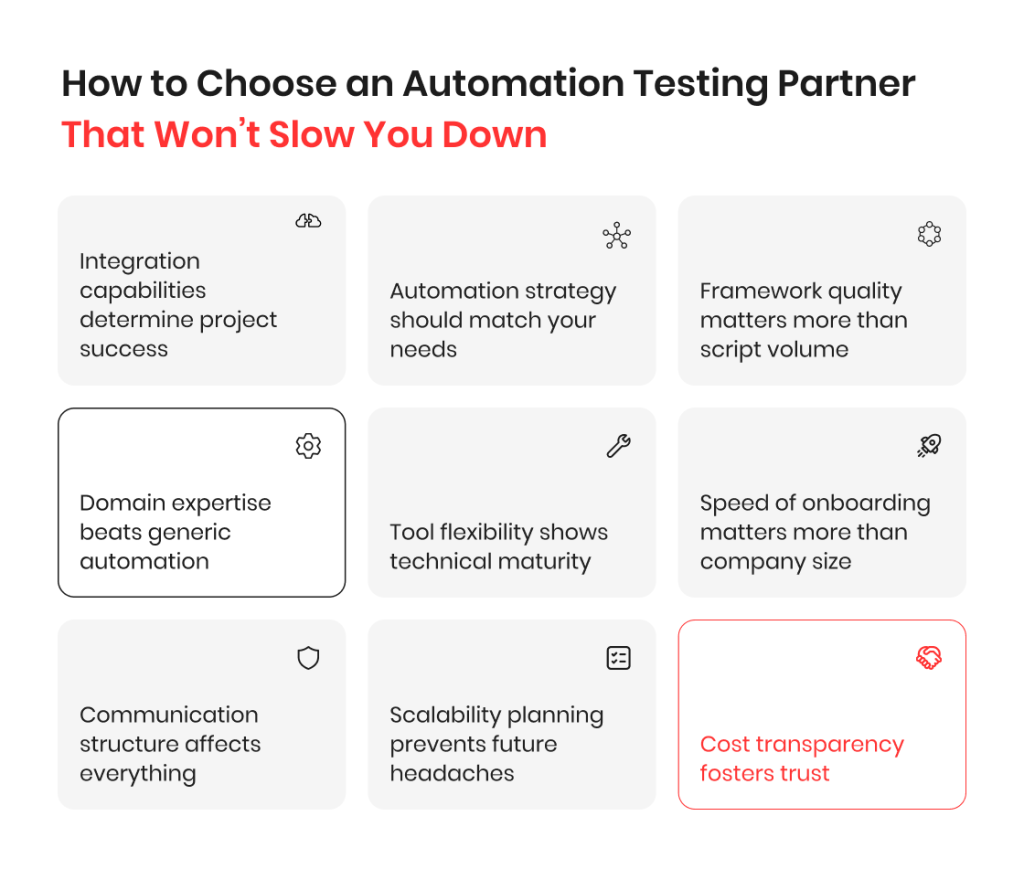
How to Choose an Automation Testing Partner That Won’t Slow You Down
Finding the right software test automation vendor means looking beyond marketing promises. Here’s what actually matters.
Technical Considerations:
1) Integration capabilities determine project success
The best automation testing companies work with your existing tools and processes instead of forcing you to change them. They should integrate with your CI/CD pipeline, project management tools, test management systems, development workflow, and reporting structure without creating extra friction for engineering teams.
Ask whether they can work with your existing stack, including Jira, GitHub, GitLab, Azure DevOps, Jenkins, TestRail, Zephyr, BrowserStack, cloud environments, and your chosen automation frameworks.
2) Automation strategy should match your needs
Not every project needs automation everywhere. Some products need heavy regression automation. Others need a smaller, risk-based suite with strong exploratory testing around high-impact flows.
The right partner will assess your product, release cadence, team capacity, and risk profile before recommending an automation strategy. They should explain what to automate first, what to leave manual, and how they will keep scripts maintainable as the product changes.
3) Framework quality matters more than script volume
A weak automation suite can become a maintenance burden. Before choosing a partner, ask how they structure frameworks, manage test data, handle flaky tests, support cross-browser and cross-device coverage, and keep automated tests stable inside CI/CD pipelines.
The best QA automation companies focus on maintainability, not only speed. A smaller, stable suite is often more valuable than hundreds of brittle tests that fail for the wrong reasons.
4) Domain expertise beats generic automation
A QA team that understands fintech compliance, healthcare workflows, eCommerce checkout logic, or SaaS subscription models will automate better test scenarios than a team that only follows generic scripts.
Domain expertise helps automation teams prioritize critical flows, high-risk integrations, regulatory requirements, and revenue-impacting functionality.
5) Tool flexibility shows technical maturity
Avoid vendors locked into one tool or framework. Selenium, Playwright, Cypress, Appium, REST Assured, Postman, JMeter, K6, Tosca, and other tools all have different strengths.
The best software test automation companies adapt the toolchain to your architecture, team skills, budget, and long-term maintenance needs.
Business Considerations:
1) Speed of onboarding matters more than company size
Look for teams that can start productive work within weeks, not months. Large companies may have impressive resources, but complex onboarding can delay actual automation work.
A mature automation partner should quickly understand your product, identify high-value automation candidates, review your current test coverage, and suggest an initial roadmap.
2) Communication structure affects everything
You need clear reporting, regular updates, and direct access to people who understand the technical details. Avoid companies that route every question through account managers who cannot explain test failures, automation gaps, or framework decisions.
Good communication should include defect reports, test execution summaries, automation coverage updates, flaky test analysis, and release risk notes.
3) Scalability planning prevents future headaches
Your testing needs will change as your product grows. Choose partners who can scale up during major releases, scale down during maintenance periods, and add specialized skills when needed.
Automation teams should also plan for long-term scalability inside the test suite itself. As features grow, the framework should remain maintainable, readable, and useful for release decisions.
4) Cost transparency fosters trust
The best vendors offer transparent pricing and avoid hiding costs behind vague consultation fees or unexpected charges for standard activities.
Ask what is included in the price: framework setup, test design, scripting, maintenance, reporting, CI/CD integration, test data setup, and ongoing support. Automation is rarely a one-time expense, so maintenance costs should be clear from the beginning.
Wrapping Up
The best automation testing companies don’t just find bugs. They reduce regression time, improve release confidence, and help teams ship faster without increasing production risk.
Key decision factors are simple: automation depth, integration capabilities, framework maturity, domain expertise, and speed of onboarding. Everything else is secondary.
Don’t be swayed solely by impressive client lists or broad service portfolios. The right QA automation companies understand your industry, work with your tools, and start delivering value within weeks, not months.
Most importantly, choose a team that acts like a partner, not a vendor. The best automation testing companies take ownership of results and help improve your entire development process, not just test individual features.
Quality assurance is too critical to get wrong. Pick a partner that has proven they can deliver under pressure, scale with your growth, and maintain automation standards that protect your reputation and revenue.
Frequently Asked Questions
 How do I choose the best automation testing company?
Look for proven automation experience, framework design skills, CI/CD integration, tool flexibility, domain expertise, and clear reporting. The best automation testing companies should explain what to automate first, what to keep manual, and how they will maintain the suite long term.
What testing tools should automation companies know?
A strong QA automation team should work with tools like Selenium, Playwright, Cypress, Appium, Postman, REST Assured, JMeter, K6, TestRail, Jira, Jenkins, GitHub Actions, GitLab CI, BrowserStack, and cloud testing environments.
Is test automation better than manual testing?
Not always. Automation is best for repetitive, stable, and high-value checks like regression, API validation, and smoke testing. Manual testing is still important for exploratory testing, usability, edge cases, and new features that change often.
When should a company start test automation?
Start automation when your product has stable core flows, frequent releases, recurring regression work, and enough QA or development capacity to maintain automated tests. Automating too early can create brittle scripts that break with every product change.
Share:


- Top 10 Software Test Automation Companies
- #1. TestFort
- #2. Qualitest Group
- #3. QASource
- #4. Infosys
- #5. QA Mentor
- #6. QArea
- #7. ScienceSoft
- #8. Tricentis
- #9. Accenture
- #10. Cigniti, a Coforge Company
- How to Choose an Automation Testing Partner That Won’t Slow You Down
- Wrapping Up
Planning to improve development process?
Decrease the entropy of product design and development, and increase your chances of success.


Let’s create a product that finally puts you on the map
Written by


We Help With
Your tech partner needs to be well versed in all kinds of software-related services. As the software development process involves different stages and cycles, the most natural solution is to have them all performed by the same team of experts. That’s exactly what our diverse range of services is for.
The choice of technology for your software project is one of the defining factors of its success. Here at QArea, we have hands-on experience with dozens of popular front-end, back-end, and mobile technologies for creating robust software solutions.
In-depth familiarity and practical experience with key technologies are one of the cornerstones of successful software development and QA. But it also takes specific knowledge of the industry to develop a solution that meets the expectations of the stakeholders and propels its owner to success.


Ensure an effective online presence for your business with a corporate site.