


AI in the Fitness Industry: How AI Is Transforming Fitness Apps and Workouts
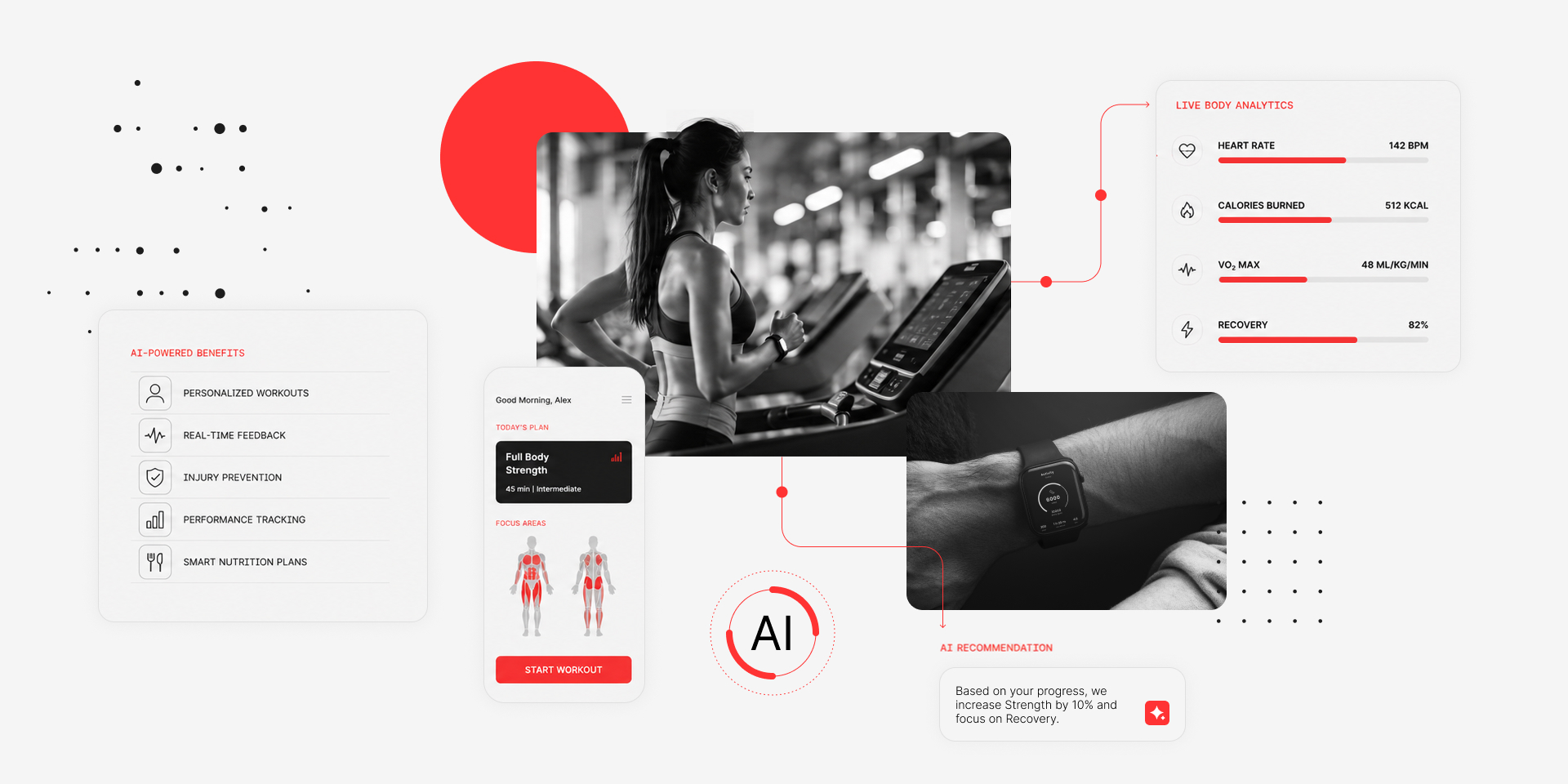
Most fitness apps that fail don’t do it because they lack features — they fail because they assume people behave consistently. In reality, workouts get skipped, motivation fluctuates, and even well-designed workout plans fall apart the moment they meet real life. This is the gap AI is starting to address — not by making fitness easier, but by making it more responsive to how people actually train.
How to know exactly how fast that transformation is happening? Here are a few most telling signs:
- Fitness apps now reach hundreds of millions of users globally, with billions of downloads each year
- Wearable devices and fitness trackers generate continuous data that would be impossible to interpret manually
- Products are moving from static workout routines to systems that adjust in real time
This is exactly where AI starts to matter, and not just as another feature, but as a layer that connects data, behavior, and decision-making. At the same time, reality is always more complex than article headlines. Yes, AI enhances fitness routines in several crucial ways, but it also introduces new risks and ethical considerations. Right now, the most interesting thing to monitor is the point where all those lanes meet — that way, we can get the most realistic idea of where AI in fitness currently stands and where it can go from here. This is exactly what this article is about, so let’s find out how the fitness industry and AI can co-exist.
Key Takeaways
- AI in fitness delivers the most value when it continuously adjusts workouts based on real user behavior rather than relying on static workout plans created at the start.
- Personalized workout plans improve over time, but only if the underlying data — including workouts, recovery, and consistency — is accurate and complete.
- Wearable devices and fitness trackers play a critical role by providing the data needed to support meaningful AI-driven recommendations.
- Adding advanced AI features does not compensate for weak core functionality, and can even highlight gaps in product design or content quality.
- AI improves efficiency by refining workout routines and recommendations, not by reducing effort or replacing disciplined training.
- The most effective fitness solutions combine AI capabilities with established training principles and human expertise where needed.
- The future of AI in fitness will depend less on new features and more on how reliably systems support real-world behavior and build user trust over time.
The Role of AI in the Fitness Industry of 2026
The fitness industry in 2026 looks very different from what it was even five years ago. It’s not even the current, undeniably impressive market size that is predicted to reach $15 billion by the end of 2026 — it’s the projected annual growth of up to 26%. Static workout plans and generic apps are being replaced by systems that respond to user behavior in real time. At the center of this shift is AI, increasingly treated as a core layer that connects data, decisions, and user experience.
From tracking to interpretation
Earlier fitness apps focused on tracking steps, calories, and workout duration, but that data had limited value on its own. AI changed this by enabling pattern analysis across workouts, consistency, and recovery, allowing apps to adjust workout routines based on real behavior rather than predefined assumptions.
Wearables and continuous data streams
The rise of wearable devices and fitness trackers has made continuous data collection the norm. AI algorithms process this data to detect trends in fatigue, recovery, and performance, helping fitness apps move from passive tracking to actionable recommendations.
Changing user expectations
There is no shortage of great fitness apps out there — in 2025 alone, there were nearly 4 billion health and fitness app downloads. However, users now expect a fitness app to behave more like a fitness coach, offering personalized workout plans that adapt over time. This includes adjusting for missed sessions, responding to current fitness level, and providing guidance that reflects real-life constraints rather than ideal scenarios.
Impact on the fitness business side
AI is also reshaping how a fitness business operates by providing insight into user behavior, engagement, and retention. Companies use this data to refine fitness solutions, improve onboarding, and design products that better match how users actually train.
From add-on features to core systems
There is a clear shift from treating AI as an add-on feature to building products around it. AI-powered fitness apps increasingly rely on continuous learning routines, where data is collected, processed, and used to improve recommendations over time.
Where AI still needs context
Despite these advances, AI cannot fully interpret individual health conditions, complex training goals, or nuanced human factors. It works best as a support tool, complementing established training principles rather than replacing them.
Transform your idea into a niche-defining product with AI development

The Use of AI in the Fitness Industry: Core Capabilities Explained
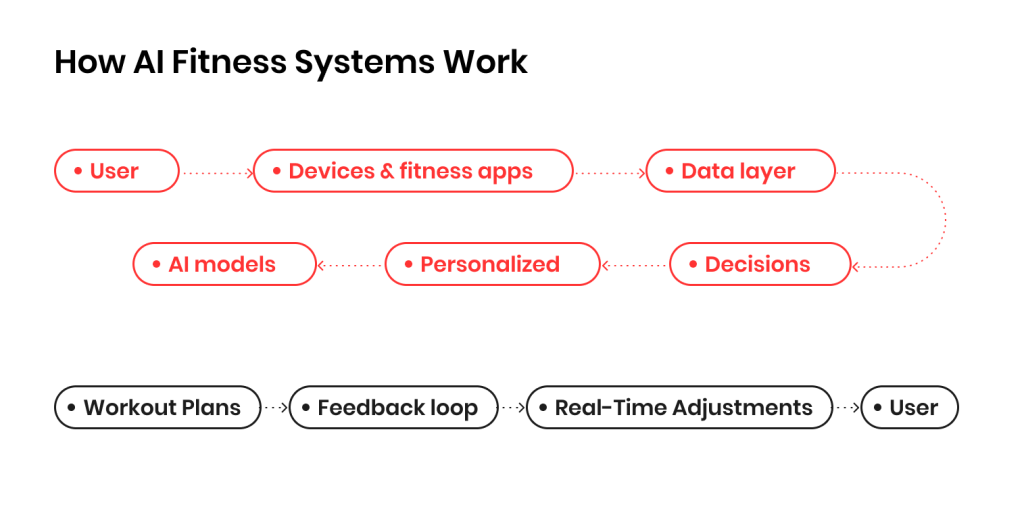
The use of AI in fitness is not about a single feature. It combines systems that collect data, process it, and turn it into decisions that shape workouts, recovery, and progress. Most AI fitness apps rely on a few core capabilities that define how the product works in practice.
Personalization that goes beyond templates
AI-based fitness systems move beyond fixed workout plans by creating personalized workout plans that adapt over time. By analyzing performance, consistency, and fitness level, they adjust workout routines to reflect real behavior. This allows AI to personalize workouts in a way that feels more realistic and sustainable. As one Reddit user points out,

“The programming is solid for general population clients… check-ins are automated and surprisingly personalized. At $15-30/month, they’re not replacing elite coaching, but they’re absolutely replacing the bottom tier.”
Real-time feedback during workouts
AI-powered fitness apps use computer vision to analyze movement and provide feedback during a workout. This helps users improve form, track reps, and make corrections in real time, making solo sessions closer to working with a fitness coach, though accuracy still depends on setup and device quality.
Predictive insights and training adjustments
AI algorithms analyze patterns across workouts to detect fatigue, inconsistency, or stalled progress. Based on this, a fitness app can adjust intensity, add recovery, or update workout and nutrition plans, helping users stay on top of their fitness goals.
Conversational coaching and AI tools
AI tools support coaching through conversational interfaces that answer questions, suggest adjustments, and guide fitness plans. These systems can use past interactions as context, making them more useful over time, although they still don’t have full awareness of individual constraints.
Data aggregation across devices and platforms
AI connects data from wearable devices and fitness trackers, combining activity, recovery, sleep, and workout history into a single view. This allows apps to produce more relevant insights and support a more complete approach to health and fitness.
Benefits of AI in Fitness: Where Does It Create Real Value?
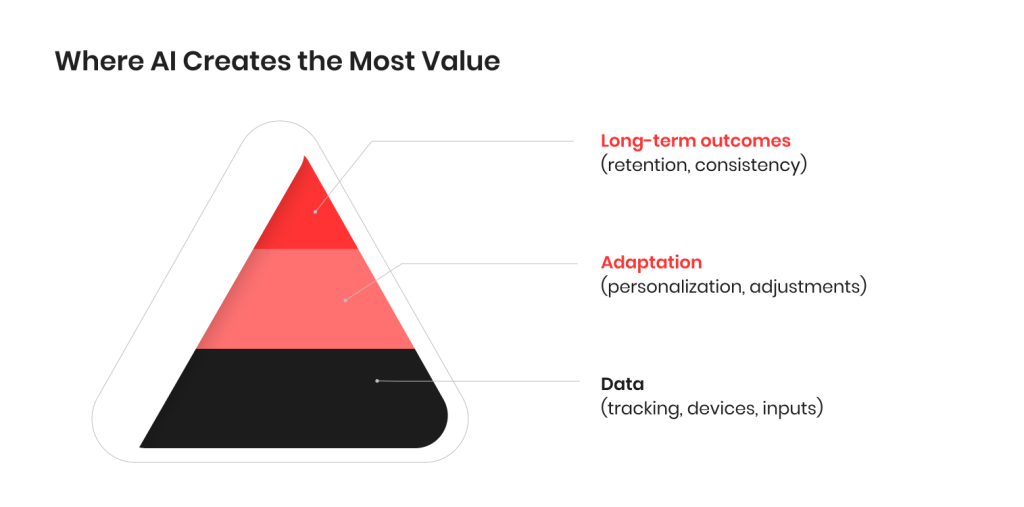
The benefits of AI in fitness are most visible when they translate into better consistency, smarter decisions, and more effective workouts. Instead of adding unnecessary complexity, AI improves how training works over time by making small, relevant adjustments based on real user behavior.
More relevant and personalized training
One of the key benefits of AI in fitness is the ability to offer personalized workout plans that adapt instead of staying fixed. Rather than following generic workout routines, users get guidance shaped by past workouts, progression trends, missed sessions, and recovery signals. This allows AI to personalize workouts in a way that reflects how people actually train, making plans feel more realistic and easier to follow.
Better consistency and long-term engagement
Many users struggle to stay consistent, even with well-designed workout plans. AI helps by adjusting recommendations when routines change, suggesting shorter or lower-intensity workouts after missed sessions and keeping targets achievable. This flexibility makes fitness easier to maintain in real life, which is one of the main drivers of long-term engagement.
More efficient workouts
AI has made workouts more efficient by focusing on what delivers results for each user. Instead of repeating generic fitness plans, users follow routines that prioritize effective exercises, reduce unnecessary volume, and adjust intensity based on performance. Over time, this leads to better results without requiring more effort or longer sessions.
Improved decision-making for users and businesses
Another benefit of AI is better decision-making. For users, it reduces guesswork by suggesting when to push harder, when to rest, and how to adjust fitness plans based on progress. For a fitness business, AI provides insight into engagement, retention, and drop-off points, helping teams refine fitness solutions based on actual behavior rather than assumptions.
Scalable coaching and accessibility
AI-powered fitness apps make structured guidance more accessible, especially for users without a personal trainer. They can provide workout plans, reminders, and basic coaching support, acting as a lightweight fitness coach for everyday training. While this does not replace professional expertise, it makes consistent training more accessible to a wider audience.
Integration across devices and ecosystems
AI also adds value by connecting data from wearable devices and fitness trackers into a single system. By combining activity data, recovery signals, sleep patterns, and workout history, AI creates a more complete view of health and physical shape. This supports a more informed and connected approach to fitness and wellness, where decisions are based on multiple inputs rather than isolated metrics.
We’ll implement AI only where it really matters and give your app a powerful competitive advantage

Key AI Technologies Used in Fitness Apps
Most AI fitness apps rely on a small set of core technologies that handle different parts of the experience, from analyzing movement to generating recommendations. It’s worth noting that the real impact comes from how these AI technologies work together inside a fitness app rather than from any single technology.
Computer vision for movement analysis
Computer vision is widely used to analyze movement during a workout. By tracking body position and joint angles through a device camera, AI can count reps, assess form, and provide feedback in real time. This is especially relevant for strength training and guided home workouts, although accuracy still depends on setup and device quality.
Time-series analysis for wearable data
Wearable devices and fitness trackers produce continuous streams of data such as heart rate, activity, and sleep. Time-series models process this data over time, helping AI detect patterns like fatigue, recovery trends, and consistency. This allows fitness apps to adjust recommendations based on long-term behavior rather than single sessions.
Recommendation systems for personalized workouts
Recommendation systems are at the core of how AI can create tailored workout experiences. They evaluate user behavior, progress, and preferences to suggest workouts, exercises, and fitness plans that evolve over time. This is what helps personalized workout plans improve as users continue training.
Generative AI for coaching and content
Generative AI supports conversational features and flexible content inside AI-powered fitness apps. It can generate workout suggestions, answer questions, and help structure fitness plans based on user input. This makes interaction more natural, although results still need to be interpreted with care.
Sensor fusion across devices and platforms
Sensor fusion combines data from multiple sources, including wearable devices and fitness apps. By linking activity, recovery, and sleep data, AI can create a more complete view of user behavior and support more accurate recommendations across fitness routines.
Natural language processing for user interaction
NLP helps users interact with AI tools in a more intuitive way. It allows systems to understand input such as fitness goals or constraints and respond with relevant suggestions, making fitness apps easier to use without relying on rigid inputs.
Best AI Use Cases in the Fitness Industry
AI is already used across a wide range of products in the fitness space, but not all use cases deliver the same value. The most effective ones are those that improve workouts, increase consistency, or help a fitness business make better decisions based on real data. Here is where the use of AI helps fitness business reach their goals:
- Personalized workout planning. AI creates personalized workout plans based on fitness level, past workouts, and consistency, helping users achieve their fitness goals more effectively.
- Real-time workout feedback. Computer vision analyzes movement during a workout, providing feedback on form, reps, and execution, especially in strength training.
- Recovery and fatigue management. AI analyzes data from wearable devices and fitness trackers to adjust workout routines based on recovery and fatigue signals.
- AI coaching and virtual assistants. AI fitness tools act as a basic fitness coach, guiding users, answering questions, and suggesting adjustments without requiring a personal trainer.
- Workout and nutrition plans integration. Some fitness apps combine workout and nutrition plans, allowing AI to provide coordinated recommendations based on activity and goals.
- Habit tracking and behavioral reminders. AI analyzes user behavior and sends adaptive reminders or suggestions to improve consistency and engagement.
- Churn prediction and retention optimization. AI helps a fitness business identify disengagement patterns and adjust onboarding or content to improve retention.
- Smart gym and connected equipment. AI-enabled fitness tools and machines track performance, adjust resistance, and sync with fitness apps for a connected experience.
- Voice and conversational interaction. Natural language interfaces allow users to request workout changes or guidance without navigating menus.
- Adaptive onboarding and fitness assessments. AI evaluates fitness level and goals early to offer more relevant workout plans from the start.
- Injury risk detection. AI identifies patterns such as sudden intensity spikes or inconsistent training that may increase injury risk.
- Content generation for fitness apps. Generative AI supports scalable creation of workout descriptions, plans, and coaching content.
AI-Powered Workout App Development for a Growing Fitness Brand: New Project by QArea
Limitations of Artificial Intelligence in Fitness
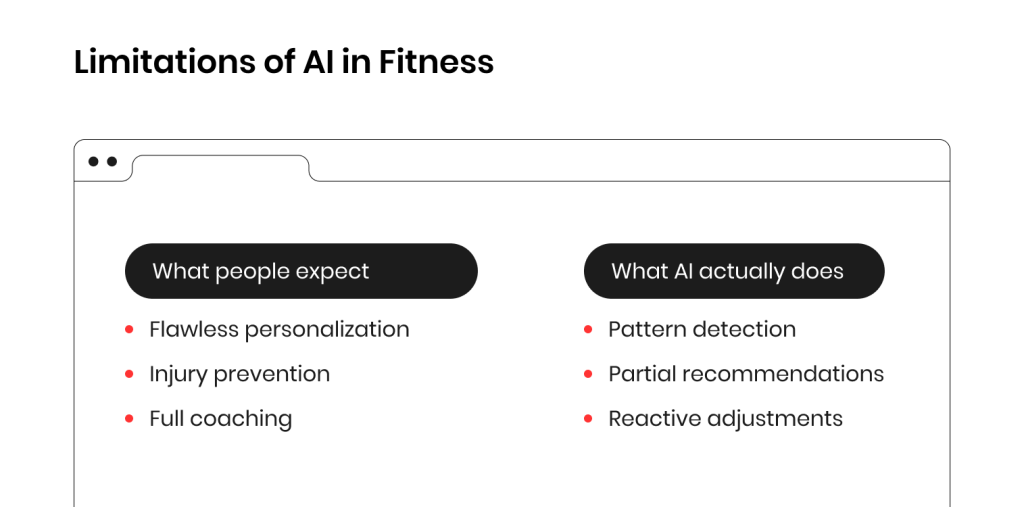
The pairing of AI and fitness has made health and wellness apps more adaptive and data-driven, but there are clear limits to what it can do at the moment. Most of these come down to context, interpretation, and real-world variability — areas where human judgment still performs better. Here is where AI still does not fully deliver:
- Limited understanding of the human body: AI can track movement and detect patterns, but it does not truly understand biomechanics or physiology, which limits how precise its feedback can be.
- Difficulty accounting for health conditions: AI struggles to reliably factor in injuries, chronic issues, or other health conditions, which can lead to recommendations that are not fully appropriate.
“AI training plans can’t account for individual fatigue, stress, diet, or life events — all major factors in safe training.”
- Cannot replace real coaching: AI can act as a basic fitness coach, but it lacks emotional awareness, accountability, and the ability to adapt to complex human factors.
- Lack of explainability: Many AI systems cannot clearly explain why workout plans or recommendations change, which can reduce user trust.
- Dependence on data quality: AI relies on consistent input, and incomplete or inaccurate data leads to weaker recommendations and less personalization.
- Cold-start problem: New users or those with limited data often receive generic suggestions until enough data is collected to personalize effectively.
- Limited adaptability to real-life variability: AI can react to patterns but struggles with unpredictable changes like schedule shifts, stress, or travel.
- Pattern recognition without context: AI algorithms identify trends but cannot fully explain underlying causes, such as why performance drops or fatigue increases.
When the Use of AI Makes Sense for a Fitness Business and When It Doesn’t
AI is often presented as a default upgrade, but in the fitness space, its value depends on context. The use of AI makes sense when it improves workouts, engagement, or decision-making. Without that, it adds complexity without a clear return.
When AI makes sense
AI is a strong fit when a fitness app depends on ongoing interaction and needs to adapt over time. It delivers the most value in products built around data, personalization, and retention.
AI makes sense when:
- The product needs to personalize workouts at scale, moving beyond static workout plans
- There is consistent, high-quality data from workouts, wearable devices and fitness trackers
- The goal is to improve long-term engagement and reduce churn
- The app includes dynamic workout routines that change based on user behavior
- The product aims to act as a fitness coach or support a personal trainer model
- The business needs insight into user behavior to refine fitness solutions
- There is a clear use case for AI, such as recommendations, feedback, or analytics
When AI doesn’t add much value
There are also scenarios where AI adds little or no practical benefit. In these cases, simpler approaches are often more effective and easier to maintain.
AI may not be necessary when:
- The fitness app offers static content like fixed workout routines or video libraries
- There is not enough data to support meaningful personalization
- User goals are simple and do not require adaptive recommendations
- Engagement is low or inconsistent, limiting the effectiveness of AI algorithms
- The product is early-stage and still validating its core value
- The main issues are related to UX, content quality, or product structure
- AI is being added without a clear purpose or measurable outcome
Finding the right balance
For most fitness businesses, the decision is not whether to use AI, but where it actually adds value.
A sensible approach is to:
- Start with specific use cases, such as personalization or analytics
- Use AI where it improves workouts or user experience directly
- Expand gradually as data and product maturity grow
- Treat AI as a tool that supports the product, not defines it
Risks and Ethical Considerations in AI-Powered Fitness
As AI becomes more embedded in fitness apps and platforms, the conversation is no longer just about capabilities. It also involves responsibility — how these systems influence user behavior, how data is handled, and what happens when recommendations are wrong. Here are the biggest risks and ethical concerns linked to the use of AI for fitness purposes:
- Risk of unsafe recommendations: AI-generated workouts may not account for individual limitations, increasing the risk of injury, overtraining, or poor alignment with fitness goals.
- Bias in AI models: Training data may not reflect different body types, fitness levels, or demographics, leading to less accurate or skewed recommendations for some users.
- Data privacy concerns: Fitness apps collect sensitive health and behavior data, raising questions about storage, usage, and potential sharing with third parties.
- Over-reliance on AI: Users may follow recommendations without understanding them, reducing awareness of their own body and limiting independent decision-making.
- Lack of transparency: AI systems often do not clearly explain how decisions are made, which can reduce trust and make it harder to identify errors.
- Blurring fitness and medical advice: As AI provides more advanced insights, users may interpret recommendations as medical guidance, which can lead to misuse.
- Inconsistent user experience: Variability in data quality, devices, and usage patterns can lead to inconsistent recommendations and uneven results.
AI Fitness Trends: The Near Future of AI Driven Fitness
The current wave of AI in fitness is only the beginning. What we are seeing now — personalized workout plans, basic coaching, and data analysis — is expanding into more integrated systems. The near future of AI-driven fitness is less about adding features and more about making them work together in a way that feels natural and consistent.
From visible features to embedded intelligence
One of the key AI trends in the fitness industry is the shift from visible features to embedded intelligence. Instead of highlighting chatbots or recommendation engines, AI is becoming part of the core experience, shaping how workouts are structured and adjusted. Systems will increasingly operate in the background, reducing the need for manual input and making interactions more seamless.
Smarter training through continuous adaptation
AI is making workouts more responsive by continuously adjusting them based on performance, recovery, and consistency. This leads to smarter training, where workout routines evolve in real time and better reflect actual user capacity. The result is a more practical approach to training that reduces the gap between planned and completed workouts.
Deeper integration with wearable devices and ecosystems
Wearable devices and fitness trackers are becoming central to AI-powered fitness. As devices and fitness apps become more connected, AI can combine activity, recovery, and behavioral data into a single system. This allows recommendations to be based on multiple signals, supporting a more complete approach to fitness and wellness.
Expansion into recovery and long-term health
Another important trend in the fitness industry in 2026 is the growing focus on recovery and sustainability. AI is being used to balance training with recovery by adjusting intensity and identifying patterns linked to fatigue. This reflects a shift in the fitness world toward long-term consistency rather than short-term performance.
Advancement of AI-powered coaching
AI-powered fitness apps are making structured guidance more accessible by acting as a scalable fitness coach. These systems can provide ongoing recommendations, feedback, and support across workouts, helping users achieve their fitness goals without direct access to a personal trainer. While these systems do not provide a replacement for professional coaching, they expand access to it.
Unification of fitness, wellness, and lifestyle data
AI is driving the streamlining of fitness and wellness into unified platforms. Instead of separating workouts, nutrition, and recovery, systems are combining them into a single experience. This creates a more connected approach to health and fitness, where decisions are based on a broader set of inputs.
More realistic expectations around AI
Even with all the talk about the revolutionary impact of AI in the fitness industry, expectations around AI are becoming more grounded. Companies are focusing less on novelty and more on reliability and measurable outcomes. This shift is shaping the next generation of AI-powered fitness apps, where value comes from consistency and usability rather than feature count.
AI Native vs. AI-Enhanced Fitness App Development
Not all AI fitness apps are built the same way. Some are designed around AI from the start, while others introduce AI features into existing products. The difference affects everything from architecture to user experience and long-term scalability.
AI-native fitness apps
AI-native products are built with AI at the core of the system, not as an add-on. In these apps, data collection, processing, and feedback loops are central to how the product works.
They are typically designed to support continuous learning and adaptation, which makes them well-suited for AI-driven fitness experiences and advanced personalization.
- Built around data pipelines and AI models from day one
- Designed to personalize workouts continuously, not periodically
- Often structured as an AI-powered fitness platform rather than a single feature
- Better suited for complex use cases like real-time feedback and adaptive coaching
- Require more upfront investment in architecture, data, and AI integration
This approach is common in newer AI fitness apps that aim to differentiate through smarter training and deeper personalization.
AI-enhanced fitness apps
AI-enhanced products start as traditional fitness apps and introduce AI features later. This is the more common approach for established platforms looking to improve existing functionality.
Instead of rebuilding the product, teams integrate AI into specific areas such as recommendations, analytics, or coaching features.
- AI is added to existing workout plans, fitness routines, or analytics
- Faster to implement compared to building an AI-native system
- Lower initial cost and complexity
- Often limited by legacy architecture and fragmented data
- Works well for incremental improvements rather than full transformation
This approach is typical for companies that want to use AI to enhance user experience without redesigning the entire product.
| Aspect | AI-native apps | AI-enhanced apps |
| Architecture | Built around AI from the ground up | AI added to existing product structure |
| Time to market | Longer due to data and system setup | Faster, builds on existing features |
| Data dependency | High — requires structured, continuous data | Moderate — works with available data |
| Personalization | Deep, continuous adaptation | Incremental improvements to existing plans |
| Cost | Higher upfront investment | Lower initial cost |
| Scalability | Strong long-term scalability if built correctly | Limited by legacy systems and data processing constraints |
| Flexibility | Easier to expand AI capabilities over time | Limited by legacy systems and data |
| Best for | New products focused on AI-driven fitness | Existing fitness apps improving features |
Which approach makes more sense?
There is no single correct choice. The right approach depends on the product stage, available data, and business goals.
- AI-native works best for new products or platforms built around personalization from the start
- AI-enhanced is more practical for existing fitness apps that need targeted improvements
- Many products move toward a hybrid model over time as AI capabilities expand
In practice, most teams start with AI-enhanced features and gradually move toward more AI-driven fitness systems as their data and product maturity grow.
We’ll help you unlock the true strategic potential of AI

Building AI-Based Fitness Apps: What It Really Takes
Building an AI-based fitness app is not just about choosing models or adding smart features. Most of the complexity comes from how data is handled, how systems are connected, and how AI is integrated into real user workflows. The difference between a working feature and a reliable product usually comes down to execution details.
Data comes first, not AI
AI depends on data, and in the fitness space, that data is often fragmented or inconsistent. Before selecting tools or models, teams need to define what data they actually have and how it will be used.
This typically includes workout history, inputs from wearable devices and fitness trackers, and behavioral signals such as consistency or drop-off points. Without a clear data structure, even the best AI algorithms will produce weak results.
Choosing between pre-built and custom AI
One of the first decisions is whether to use pre-trained models or build custom solutions. Both approaches are valid, but they serve different goals.
Pre-built AI tools are useful for:
- Faster implementation
- Standard use cases like recommendations or basic coaching
- Lower initial cost
Custom AI solutions make more sense when:
- The product relies on unique logic or data
- There is a need to differentiate the fitness app
- More control over model behavior is required
In many cases, teams combine both approaches, using existing AI technologies where possible and building custom components where needed.
AI integration with devices and fitness apps
AI does not operate in isolation. It needs to connect with devices and fitness apps, including wearables, mobile platforms, and backend systems.
This is where AI integration becomes complex. Data needs to be synchronized across multiple sources, processed in near real time, and fed back into the system without delays. Even small inconsistencies between devices and fitness apps can affect recommendations and user experience.
MLOps and continuous improvement
AI systems are not static. They require ongoing updates, monitoring, and adjustment. This involves:
- Tracking model performance over time
- Updating models as new data becomes available
- Managing versioning and testing
Without this layer, AI features degrade quickly. In AI-powered fitness apps, continuous improvement is part of the product, not an optional step.
Performance, cost, and trade-offs
AI introduces trade-offs that are easy to underestimate. Real-time feedback, for example, may require on-device processing, while deeper analysis might rely on cloud infrastructure.
Teams need to balance:
- Speed vs. accuracy
- Cost vs. scalability
- Real-time vs. batch processing
These decisions directly affect how the fitness app performs and how sustainable it is at scale.
Cross-functional delivery practices
Building AI-driven fitness products requires more than AI engineers. It involves mobile development, backend systems, product design, and QA working together.
Key roles typically include:
- AI and data specialists
- Mobile and backend developers
- QA engineers for testing AI behavior
- Product teams defining fitness logic and user flows
Without coordination across these areas, even strong AI components can fail to deliver value in practice.
Why the right technical partner matters
Building AI-based fitness apps is less about individual features and more about how AI is implemented across the product. Many teams struggle not with access to AI technologies, but with integrating them into real workflows, data pipelines, and user experiences.
A strong technical partner helps connect AI with mobile apps, wearable devices, and backend systems in a way that remains stable and scalable. This includes making early decisions around data structure, model selection, and how AI features will evolve over time.
At QArea, we approach AI-powered fitness apps as full-cycle products. By combining AI expertise with development and independent QA, we build and enhance fitness apps where AI delivers practical value, improving workouts, user experience, and long-term engagement.
What you shouldn’t underestimate
In real projects, the biggest challenges are rarely the ones expected at the start.
- Data readiness often takes longer than model selection
- Integration with wearable devices is more complex than it appears
- Product fit matters more than model accuracy
Final Thoughts
AI is already shaping how the fitness industry builds products, but its real impact depends less on technical sophistication and more on how well it fits into everyday behavior. The gap between what AI can generate and what users actually follow is still significant. The products that stand out are not the ones with the most advanced features, but the ones that support consistency, adjust to real constraints, and make workouts easier to sustain over time.
For teams building in this space, the key question is not how to use AI everywhere, but where it genuinely improves outcomes. As AI becomes less visible and more embedded, differentiation will come from execution, data quality, and trust. In reality, AI works best as a multiplier — rarely compensating for weak fundamentals, but rather strengthening a well-designed fitness app.
FAQ
 Are AI fitness apps actually effective?
They can be, especially for consistency and basic structure. Their effectiveness depends on how well they adapt to your behavior and how consistently you use them.
Can AI replace a personal trainer?
Not fully. AI can guide workouts, suggest adjustments, and track progress, but it lacks human judgment, accountability, and the ability to interpret complex situations like injuries or motivation.
Is AI safe to use for workouts?
Generally yes for healthy users, but it’s not a substitute for medical advice. If you have injuries or health conditions, you should not rely on AI recommendations alone.
Will AI make fitness easier in the future?
Not easier, but more manageable. AI is likely to reduce guesswork and help people stay consistent, which is often the hardest part of fitness.
What’s the biggest mistake companies make with AI in fitness?
Adding AI without a clear purpose. If it doesn’t improve workouts, engagement, or decision-making, it becomes an unnecessary layer rather than a useful tool.
What should I ask before partnering with QA consulting companies?
Ask about industry experience, sample deliverables, onboarding time, communication, time zone overlap, tools, automation approach, security practices, and success metrics. The best QA consulting companies should explain how they will improve product quality, not just provide testers.
Share:


- Key Takeaways
- The Role of AI in the Fitness Industry of 2026
- The Use of AI in the Fitness Industry: Core Capabilities Explained
- Benefits of AI in Fitness: Where Does It Create Real Value?
- Key AI Technologies Used in Fitness Apps
- Best AI Use Cases in the Fitness Industry
- Limitations of Artificial Intelligence in Fitness
- When the Use of AI Makes Sense for a Fitness Business and When It Doesn’t
- Risks and Ethical Considerations in AI-Powered Fitness
- AI Fitness Trends: The Near Future of AI Driven Fitness
- From visible features to embedded intelligence
- Smarter training through continuous adaptation
- Deeper integration with wearable devices and ecosystems
- Expansion into recovery and long-term health
- Advancement of AI-powered coaching
- Unification of fitness, wellness, and lifestyle data
- More realistic expectations around AI
- AI Native vs. AI-Enhanced Fitness App Development
- Building AI-Based Fitness Apps: What It Really Takes
- Final Thoughts
Planning to improve development process?
Decrease the entropy of product design and development, and increase your chances of success.

Hire a team
Let us assemble a dream team of specialists just for you. Our model allows you to maximize the efficiency of your team.
Written by

We Help With
Your tech partner needs to be well versed in all kinds of software-related services. As the software development process involves different stages and cycles, the most natural solution is to have them all performed by the same team of experts. That’s exactly what our diverse range of services is for.
The choice of technology for your software project is one of the defining factors of its success. Here at QArea, we have hands-on experience with dozens of popular front-end, back-end, and mobile technologies for creating robust software solutions.
In-depth familiarity and practical experience with key technologies are one of the cornerstones of successful software development and QA. But it also takes specific knowledge of the industry to develop a solution that meets the expectations of the stakeholders and propels its owner to success.


Ensure an effective online presence for your business with a corporate site.